The Porch Trap: How High-Pressure Energy Reps Push You Into Bad Deals (And How to Stop Them)

# The Porch Trap: How High-Pressure Energy Reps Push You Into Bad Deals (And How to Stop Them)
It starts with a knock at the door, a friendly wave from someone standing near a kiosk at your local grocery store, or a table set up just inside the entrance of a big-box retailer. The person is smiling, wearing a safety vest or a branded polo, and holding a clipboard or tablet. They tell you they are in the neighborhood to check on your electric rates, or they catch you mid-shopping to ask if you have seen the "new savings program" for your zip code.
It sounds like a helpful service. But in Texas, where millions of residents choose their own electricity provider, high-pressure direct sales, whether on your porch, at a store kiosk, or inside a retail location, are carefully engineered to bypass your natural caution, exploit complex utility rules, and lock you into contracts that could cost you hundreds of dollars more each year.
Before you hand over your electric bill or sign a mobile device on your front step or at a checkout counter, here is what you need to know about how these tactics work and how to protect your wallet.
The 4 Red Flags of a High-Pressure Energy Pitch
Whether someone catches you at home or while you are pushing a cart through the grocery store, direct energy sales rely on creating immediate rapport while subtly removing your time to think. Watch for these four common warning signs:
1. The "Utility Official" Illusion
Salespeople rarely start by saying, "Hi, I work for an independent retail electricity provider." At your door, they wear high-visibility vests, lanyards, or badges designed to look like official utility uniforms. At a store kiosk, they set up branded tables with professional signage that can look like an official utility outreach program. In both cases, they frequently name-drop your local Transmission and Distribution Utility (TDU), whether that is Oncor, CenterPoint, AEP Central, AEP North, TNMP, or LP&L, to imply they are grid technicians, state regulators, or authorized utility representatives.
Your TDU delivers electricity and maintains the power lines. They do not sell retail plans, and they do not send salespeople to your door or set up enrollment tables at your grocery store.
2. The Bill Trap
One of the rep's main goals is to see your utility bill. At your door, they might ask to "verify a rate code." At a store kiosk, they often ask you to pull up your bill on your phone or offer to "scan it real quick" to check your savings eligibility. This is a tactic. Your utility bill contains your unique account number and ESIID (Electric Service Identifier), which is the number tied to your specific meter. With that information, an aggressive salesperson can process an unauthorized provider switch, an illegal practice known as "slamming," sometimes without your clear understanding of what you signed.
The Public Utility Commission of Texas (PUCT) tracks slamming complaints every year, and it remains one of the most common violations reported by Texas electricity customers.
3. Manufactured Urgency
"This rate cap expires at 5 PM," or "I am only in your zip code today to sign up houses on this feeder line." In stores, you might hear "We are only set up here through Saturday" or "This promotional rate is only for customers who sign up in store today." Artificial deadlines exist for one reason: to keep you from stepping away, opening a browser, and comparing their offer against the hundreds of transparent plans available online.
Any legitimate electricity rate will still be available after you have had time to think. If a deal truly disappears before you finish your grocery run, that alone tells you something about it.
4. Exploiting Tariff Complexity
Electricity pricing in Texas can be confusing, and sales reps know it. They often highlight a single low "energy charge" while conveniently omitting the full picture: TDU delivery charges that every plan carries, fixed monthly service fees, tiered usage thresholds that raise your rate if you go over a certain number of kilowatt-hours, or steep rate jumps after an introductory period ends.
A plan advertised at 8 cents per kWh at the door might actually cost 12 to 14 cents when you factor in TDU delivery, monthly fees, and usage-tier penalties. Every Texas retail electricity plan is required to have an Electricity Facts Label (EFL) that shows the true all-in cost at 500, 1,000, and 2,000 kWh. But door-to-door reps rarely hand you one, and the terms scrolling by on a tablet screen are easy to miss.
This is exactly why tools like GridWise Audit exist. GridWise gives you access to over 1,500 Texas electricity plans, including plans available on PowerToChoose in addition to broker-negotiated rates, with EFL links and all-in pricing displayed upfront. When you can see the full cost breakdown side by side, a bad deal has nowhere to hide.
Your Front-Door Defense Checklist
You are under no obligation to engage with anyone soliciting products at your home, at a store kiosk, or in any public space. A polite "no thanks" is a complete sentence. If you do choose to talk to an energy salesperson, follow these rules:
- Keep your bill private. Never let a salesperson inspect, photograph, scan, or copy down information from your electric bill, whether it is a paper copy at your door or pulled up on your phone at a store. Do not share your ESIID or account number unless you have already decided to enroll with their company.
- Ask the identification question. Ask point-blank: "Are you an employee of my local electric delivery utility, or do you work for an independent retail provider?" A legitimate rep will answer clearly. Hesitation or deflection is your signal to end the conversation.
- Demand paper disclosures. If a rep claims they can only show you terms on their tablet screen and cannot leave behind paper documentation, a printed EFL, or a link for later review, walk away.
- Enforce a 24-hour pause. Never sign a contract on the spot. A genuine rate offer will still be available tomorrow after you have had time to read the fine print and compare options using independent tools.
Buyer's Remorse? What to Do If You Already Signed
If you realized after the rep walked away, or after you got home from the store, that you signed up for a contract you do not want, do not panic. Texas law gives you clear protections:
- Exercise your right to cancel. Under PUCT Substantive Rule 25.474, Texas customers who are switched to a new retail electric provider through a door-to-door or telephone solicitation have the right to rescind the enrollment. Federal rules also provide a 3-business-day cooling-off period for contracts signed at your home. During this window, you can cancel with zero financial penalty or early termination fees.
- Contact your TDU and current provider. Call your local TDU (the number on your electric bill) and your current retail provider. Inform them that you did not authorize a switch in your electricity service, or that you have cancelled the pending enrollment.
- File a complaint with the PUCT. If a salesperson used deceptive tactics, misrepresented themselves as a utility official, or switched your service without your consent, file a formal complaint with the Public Utility Commission of Texas at (512) 936-7120 or online at puc.texas.gov. You can also contact the Texas Attorney General Consumer Protection Division.
How to Actually Compare Plans on Your Terms
The best defense against a bad pitch is knowing what a good plan looks like for your household before someone shows up at your door.
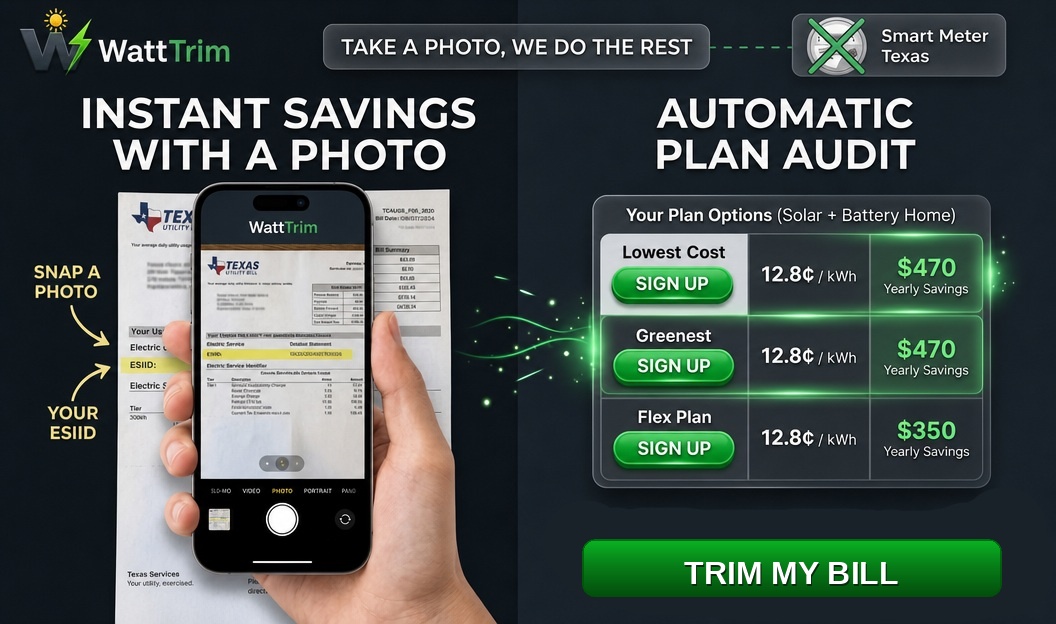
WattTrim connects directly to your smart meter through the Texas Smart Meter network and pulls your actual usage data. Instead of guessing your consumption or relying on a salesperson's estimate, WattTrim analyzes how much electricity you use and exactly when you use it. That includes time-of-use insights that show whether your peak hours fall during a plan's most expensive windows or its cheapest off-peak periods.Your real usage patterns are then compared against over 1,500 Texas electricity plans to find which ones genuinely save you the most, not which ones pay the highest sales commission. The analysis is always free, takes minutes, and your results are never influenced by provider compensation.
If a door-to-door rep ever quotes you a rate, you will already know whether it is a deal or a trap.
The Bottom Line
Choice in energy providers is designed to save Texas consumers money, but the best deals are rarely sold under pressure on your front porch or at a folding table in aisle nine. By keeping your account details safe, demanding written disclosures, and using independent tools to research plans on your own schedule, you keep your electricity bill under your control, not someone else's.
WattTrim's plan rankings are based solely on your actual usage data. Provider compensation never influences your results.
Put This Knowledge to Work
Compare your current plan against 1,500+ options across all 6 Texas TDU service areas, including exclusive broker-negotiated rates not found on PowerToChoose.org. Always free.
Trim My Bill