Best Electricity Plan for a Powerwall in Texas: Why the Plan Matters More Than Automation
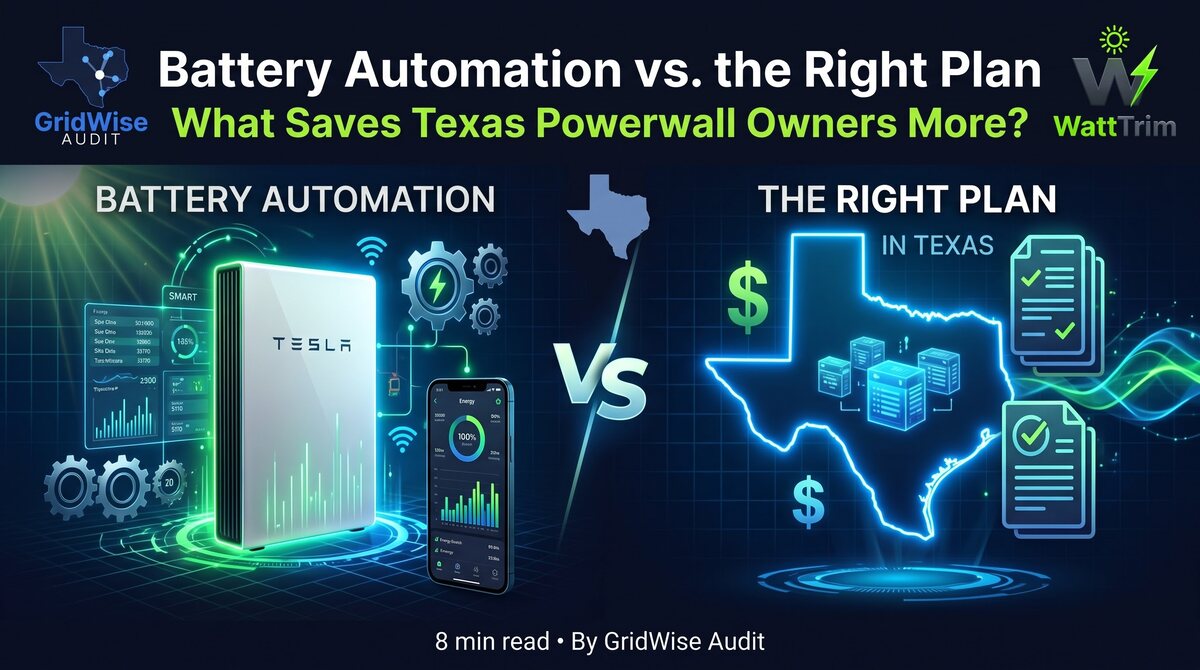
If you own a home battery in Texas, you have two ways to lower your electricity bill. You can change how the battery runs, using the settings in your battery app or a third-party automation app. Or you can change the plan you buy electricity on.
Both can save money. But they are not equal. In Texas, the right plan usually matters more, and automation only adds value on top of the right plan. A well-run battery on the wrong plan can still lose money. The same battery on the right plan, even with simple settings, often comes out ahead.
This guide explains why, which plans actually reward a smart battery, and the order to tackle things in.
Two Different Decisions
Battery automation and plan choice answer different questions:
- Battery automation decides when. When the battery charges, when it powers the house, when it holds energy in reserve, and when it sends energy to the grid.
- Your plan decides how much. What you pay for every kWh you buy, what you earn for every kWh you sell, and which credits and fees apply.
What Battery Automation Can Do
A good battery strategy can:
- Shift usage in time. Store solar or low-cost energy and use it later, when grid power costs more.
- Hold energy for price spikes. On plans that pay market prices for exports, a battery can wait for a high-price window instead of exporting at a low price.
- Protect backup reserve. Keep enough stored energy for an outage.
- Battery size. A typical home battery stores around 13 to 14 kWh. That is the most it can shift in one cycle, no matter how clever the software is.
- Round-trip losses. Roughly 10% of the energy put into a battery is lost when it comes back out.
- Delivery charges. If the battery charges from the grid, you still pay TDU delivery charges on that energy, even during hours with a low or zero energy charge.
- Texas wholesale prices are low most of the time. Midday prices, when solar exports are highest, are often only a few cents per kWh. High-price spikes do happen, but they are short and unpredictable.
What Your Plan Controls
Your plan applies to every kWh you buy and sell, every month. It sets:
- The energy rate on everything you import from the grid
- The buyback rate on everything you export
- Bill credits that apply only when your usage reaches a set level
- VPP credits for letting a provider use your battery during grid events
- Fees, including base charges, minimum usage fees, and cancellation fees
That is why the plan is usually the bigger lever. Automation works within the limits of one battery. The plan works on your whole bill.
When Automation Can Work Against You
On some plans, a smarter battery can actually cost you money:
- Bill credit plans. Many plans pay a credit only when your monthly usage reaches a threshold, such as 1,000 kWh. If the battery powers more of your home and grid usage drops below that line, you lose the whole credit for the month. Our guide to tiered pricing and bill credits explains how these work.
- Minimum usage fees. Some plans charge a fee when usage falls below a set level, such as 400 kWh. Lower grid usage can trigger it.
- VPP programs. When you join a virtual power plant program, the provider usually controls when the battery charges and discharges. A third-party app sending its own commands may conflict with that control, and some programs require specific settings to pay the full credit. Check with both the app and the provider before combining them.
Which Plans Reward a Smart Battery
Not every plan gives a battery anything to work with. It helps to sort plans by whether timing matters on the import side (what you buy), the export side (what you sell), or both.
Plans That Reward Timing on Both Sides
A small number of solar plans vary both the import rate and the export rate by time of day, or pair time-of-use import pricing with a buyback tied to real-time wholesale prices. On these plans, a battery can avoid buying during expensive hours and sell during valuable hours. This is where automation has the most room to add value.
These plans often come with conditions, such as limits on system size, rules about exporting more than you use, or higher base charges. Some also give the provider control of the battery in exchange for credits, which leaves little room for your own automation.
Plans That Reward Timing on One Side
- Export side only. Plans with a flat import rate and a buyback that follows wholesale market prices. A battery can hold energy for higher-price periods. But because midday wholesale prices are often low, the extra earnings depend heavily on catching price spikes.
- Import side only. Time-of-use plans with lower-cost or no-energy-charge hours, such as nights or weekends. A battery can charge during those hours and power the home later. TDU delivery charges still apply to the energy you buy during those hours. Note that many providers do not enroll solar customers on these plans, so check eligibility first. Our guide to nights and weekends plans covers this.
Plans Where Timing Does Little
- Flat import rate with a fixed buyback rate. Every kWh costs the same and every export earns the same, whenever it happens. A battery still helps by storing solar for your own evening use instead of exporting it at a lower rate, but advanced automation adds little.
- One-to-one credit plans. When exports are credited at the same value as imports, shifting energy in time changes very little.
The VPP Trade-Off
VPP programs pay a credit for letting the provider use your battery during grid events. Some offer a choice: a higher credit with the provider in control, or a lower credit with you in control.
The advertised credit is not the whole story. When a provider controls the battery, it may keep the battery charged and ready for the grid rather than using it to power your home in the evening. If that means you buy more grid power at higher evening rates, part of the credit is offset. The real value of a VPP is the credit minus any extra grid power you end up buying.
There is no single right answer. A fixed monthly credit is predictable. Keeping control lets you decide how the battery serves your home. The way to tell which works better for you is to look at your actual usage before and after, not the advertised credit alone.
The Right Order: Plan First, Then Settings
- Find the right plan for your actual usage. Use your real import, export, and battery patterns, not a generic 1,000 kWh estimate. Include buyback, bill credits, VPP credits, fees, and TDU delivery charges.
- Then tune the battery for that plan. If the plan rewards timing, adjust your settings or consider automation. If it does not, simple settings are usually enough.
- Check the results after a full billing month. Battery changes affect your usage, and your usage affects which plan is best. Compare again with new data.
- Read the Electricity Facts Label before enrolling. Time windows, buyback terms, and credit rules are all in the fine print.
GridWise Audit earns revenue through optional subscription services and enrollment commissions when you choose to switch through our platform. Your analysis results are never influenced by provider compensation.
Put This Knowledge to Work
Compare your current plan against 1,500+ options across all 6 Texas TDU service areas, including exclusive broker-negotiated rates not found on PowerToChoose.org. Always free.
Trim My Bill
Keep Reading

Frequently Asked Questions
What is the best electricity plan for a Tesla Powerwall in Texas?
There is no single best plan for every Powerwall owner. The right plan depends on how much you import from the grid, how much you export, when those happen, and whether you join a VPP program. A plan that suits a home with large solar exports may not suit a home that imports most of its power. Comparing plans against your own metered usage and exports is the most reliable way to find the best fit.
Should I choose Tesla Electric Fixed or Dynamic?
Tesla Electric offers two versions. Fixed pays a higher monthly VPP credit per Powerwall, and Tesla manages the battery. Dynamic pays a lower credit plus export credits based on real-time wholesale prices, and you keep full control of your battery settings. Fixed suits homeowners who want a predictable credit. Dynamic suits those comfortable with variable earnings who want control. Our VPP guide compares both in detail.
Is a battery automation app worth it in Texas?
It can be, but mostly on plans that reward timing, such as time-of-use import pricing or a buyback tied to wholesale prices. On flat-rate plans with a fixed buyback, simple battery settings usually capture most of the value. Choosing the right plan first gives automation the most to work with.
Does the right electricity plan save more than battery automation?
For many Texas homes, yes. A plan affects every kWh you buy and sell each month, while automation is limited by the size of one battery and by wholesale prices that are low most hours of the day. Your own result depends on your usage, exports, and the plans available in your area.
Which Texas plans reward a home battery the most?
Plans that vary both the import rate and the export rate by time of day, or that pair time-of-use pricing with a wholesale-based buyback. These are less common and often have conditions, so check the Electricity Facts Label for time windows, eligibility, and fees.
Can a smarter battery make my bill go up?
Yes, on some plans. If lower grid usage drops a month below a bill credit threshold, you lose the credit. If it drops below a minimum usage level, a fee may apply. Check your plan's thresholds before changing how your battery runs.
Can I use a battery automation app with a VPP program?
Possibly, but check first. Many VPP programs give the provider control of the battery and may require specific settings to pay the full credit. A third-party app sending its own commands could conflict with that. Ask both the app developer and your provider.
Is a fixed buyback rate better than a market-rate buyback?
It depends on your exports. Solar exports mostly happen at midday, when wholesale prices are often low, so a fixed buyback rate can pay more for many homes. A market-rate buyback can pay more if a battery lets you export during high-price periods.
How do I know if my VPP credit is worth it?
Compare the credit to any extra grid power you buy because the battery is held for the provider. If your evening grid usage rose after joining, part of the credit is being offset. Looking at your actual metered usage before and after enrollment is the clearest way to tell.