Virtual Power Plants in Texas: How Your Battery Brand Determines Your VPP Options
In Texas, the battery you own largely decides which virtual power plant (VPP) programs you can join. Tesla Powerwall owners can use Tesla Electric and David Energy. Enphase IQ and SolarEdge owners can use Octopus Energy, Reliant, TXU Energy, and David Energy. Chariot Energy serves Qcells battery owners. Base Power supplies its own hardware. Each program pays you differently, gives you a different level of control over your backup reserve, and requires different equipment. Understanding these differences is the first step to making your storage system work harder.
VPP terms change often. Everything below describes how each program has been structured at the time of writing. Verify current details, rates, and eligibility with the provider before you sign anything.
What a Virtual Power Plant Is, and Why It Matters in ERCOT
A virtual power plant is a network of home batteries, often thousands of them, that a software platform coordinates to act like one power plant. When the grid needs extra supply, the software draws on stored energy from many homes at once and sends it to the grid. The homeowners who own those batteries are compensated for it.
This matters in Texas because of how the grid works. ERCOT runs a competitive wholesale market where the price of electricity changes every few minutes. Most of the year prices are low. During extreme heat or cold, when demand surges and supply is tight, wholesale prices can spike as high as $5,000 per megawatt-hour, which is many times the normal price. A VPP is built to capture value during those short windows. Your battery charges when power is cheap or when your solar panels are producing, then discharges when the grid is stressed and power is valuable.
For the homeowner, the appeal is that a battery can do more than backup power and evening bill reduction. If you want background on those basics first, read why a battery, not just solar panels, is the real play. For how standard solar export credits work, see solar buyback plans in Texas explained.
The catch is that VPP programs are retail electricity plans. Joining one usually means switching your retail electric provider (REP) to the company running the VPP. That has consequences for your solar buyback credits and your rate, which we cover below.
Texas VPP Programs at a Glance
| Provider | Compatible Battery | Primary Earnings | Backup Control |
|---|---|---|---|
| Tesla Electric (Fixed) | Powerwall 2, +, 3 | $400/yr per Powerwall + fixed buyback rate | Tesla-managed, 25% reserve |
| Tesla Electric (Dynamic) | Powerwall 2, +, 3 | $120/yr per Powerwall + 90% wholesale export | Full user control via Tesla App |
| Octopus Energy | Enphase IQ, SolarEdge Energy Bank | $4/kWh of storage per month | 20%+ floor reserve guaranteed |
| David Energy | Powerwall, Enphase, SolarEdge | 90% real-time wholesale pass-through | Full user-defined reserve |
| Reliant | Enphase, SolarEdge, LG (via SolarEdge inverter) | $50/month bill credit | Customer-set reserve honored |
| TXU Energy | Enphase IQ Batteries | Financial incentives (rates not publicly disclosed) | Customer retains outage control |
| Base Power | Proprietary LFP (~39.2 kWh, Base-owned) | Low fixed import rate + grid dispatch | Automated via Base platform |
| Abundance Energy + sonnen | sonnen battery systems | Bundled retail rate (~12c/kWh + ~$20/mo) | Managed via SOLRITE platform |
| Chariot Energy | Qcells (Q.HOME) only | $40/month bill credit (up to $60) | 20% SOC floor, customer override available |
| Rhythm + Kinergy | Not yet disclosed | Announced Nov 2025, launching 2026 | Not yet disclosed |
- Hardware gate: Does your existing battery qualify, or would you have to buy new equipment?
- Earnings mechanism: Are you paid a predictable fixed amount, or a variable amount tied to wholesale prices?
- Backup control: Who decides how much battery charge is held back for an outage, you or the program?
Deep Dive: Analyzing the VPP Business Models
Tesla Electric: The Native Ecosystem Model
Hardware gate. Tesla Electric is open to Tesla Powerwall owners only. The program supports Powerwall 2, Powerwall+, and Powerwall 3. If you have a different brand of battery, this program is not available to you.Tesla Electric offers two distinct plan types, and the differences matter.
Tesla Electric FixedThe Fixed plan prioritizes predictability. You get a fixed import rate during Standard Hours (4 AM to midnight) and a lower rate during Wind Hours (midnight to 4 AM), plus a fixed export/buyback rate for solar and battery energy sent to the grid. Both rates are locked for one year.
The VPP credit is the headline: $400 per year per Powerwall, credited monthly (roughly $33/month per battery). The credit caps at $1,200 per year, which means three Powerwalls is the effective maximum. To qualify for the full credit, your Backup Reserve must be set at 25%, Tesla Electric mode must be enabled, and grid charging/discharging must be turned on. Tesla manages your battery dispatch settings on this plan.
There is no monthly base fee, no minimum usage charge, and no cancellation fee. The tradeoff is that Tesla controls when and how your battery participates, and the fixed export rate may underperform during wholesale price spikes compared to what you could earn on a market-rate plan.
Tesla Electric DynamicThe Dynamic plan gives you market exposure. Import pricing follows a time-of-use structure with an on-peak window (6 PM to 9 PM) and a lower off-peak rate (9 PM to 6 AM). Rates are updated monthly but Tesla says they are intended to remain relatively stable.
The export rate is where Dynamic stands apart: you receive 90% of the ERCOT real-time market price, calculated every 15 minutes using your nearest load-zone settlement point. When wholesale prices spike during summer peaks or winter storms, your export credits spike with them. Tesla cites a historical average of 17c/kWh exported in 2023, but that is not a guaranteed rate and will vary year to year.
The VPP credit on Dynamic is lower: $10 per month per Powerwall ($120/year), compared to $400/year on Fixed. The upside is that you retain full control of your Powerwall settings, including your Backup Reserve percentage. You decide the tradeoff between backup protection and export availability.
Dynamic is month-to-month with no cancellation fee.
Fixed vs. Dynamic: Which One?| Fixed | Dynamic | |
|---|---|---|
| VPP Credit | $400/yr per Powerwall (max $1,200/yr) | $120/yr per Powerwall |
| Export Rate | Fixed rate, locked for one year | 90% of ERCOT real-time price |
| Battery Control | Tesla-managed, 25% reserve required | You control all settings |
| Market Exposure | Lower, more predictable | Higher, can benefit from price spikes |
| Contract | One-year fixed rates | Month-to-month |
Octopus Energy: The Capacity Credit Model
Hardware gate. Octopus Energy's Intelligent Octopus program works with Enphase IQ batteries and SolarEdge Energy Bank batteries. It is a good option for homeowners who have equipment from those manufacturers and therefore cannot use Tesla Electric. Earnings mechanism. Octopus uses a fixed monthly bill credit calculated on a dollars-per-kilowatt-hour basis, currently $4 per kWh of installed storage per month. For a 10 kWh battery, that is $40/month. You are paid for the capacity you make available rather than for the specific wholesale prices that occur during events. This is the most predictable structure of the group. The tradeoff is that you generally will not see the full upside of a very high-priced grid event, since the credit does not rise and fall with the market. Octopus also covers the charging costs associated with dispatched energy and locks in a 12-month retail rate. Backup control. Octopus guarantees a reserve floor of at least 20 percent. That means a minimum share of your battery is always held back for outages. Remote dispatches will never pull your battery below that threshold. Who it tends to suit. Homeowners with Enphase or SolarEdge batteries who value a steady, forecastable credit over chasing wholesale spikes.David Energy: The Real-Time Wholesale Pass-Through Model
Hardware gate. David Energy is the broadest of the software-based programs in terms of hardware. It supports Tesla Powerwall alongside select Enphase and SolarEdge batteries. David provides connection workflows for both Enphase and Tesla systems. Which specific models qualify can change, so check the current compatibility list. If you own a Powerwall and want an alternative to Tesla Electric, David Energy is one to compare. Earnings mechanism. David Energy passes through up to 90 percent of the real-time wholesale export credit for energy your battery sends to the grid. That is the most direct link to market prices of any program here. When ERCOT prices spike, your credit spikes with it. When prices are low, so is your credit. Because this is a market-based model, income can swing widely. Backup control. Participants retain full control over their battery reserve through their OEM app settings (Tesla App, Enphase Enlighten, etc.). You decide how much charge to keep for outages, and the program works with whatever capacity is left. This gives you the most control, but it also puts the responsibility on you. Who it tends to suit. Homeowners who are comfortable with price volatility, want maximum control of their reserve, and own one of the supported batteries.Reliant (Battery Perks): The Flat Monthly Credit Model
Hardware gate. Reliant's Battery Perks program supports Enphase batteries, SolarEdge batteries, and LG battery systems when connected to a SolarEdge inverter. This is the only program that explicitly supports LG RESU systems (with the SolarEdge inverter requirement). Customers need an active Reliant account, utility interconnection approval, and Wi-Fi. Earnings mechanism. Reliant pays a flat $50/month bill credit. This is simple and predictable, though it does not scale with your battery's capacity the way Octopus's per-kWh credit does. A homeowner with 5 kWh of storage and one with 20 kWh both receive the same $50. Credits may take one to two billing cycles to begin appearing. Backup control. Reliant says it honors the customer's reserve threshold. The home receives battery power before reserves are exported to the grid. You set your reserve in your battery's own app. Who it tends to suit. Homeowners with Enphase, SolarEdge, or LG/SolarEdge batteries who want a simple, flat monthly credit without tracking market prices or capacity calculations.Chariot Energy (Battery Rewards): The Qcells-Only Add-On
Hardware gate. Chariot's Battery Rewards program currently supports only Qcells (Q.HOME) batteries. Tesla Powerwall, Enphase, SolarEdge, and LG systems are not eligible at this time, though Chariot says they are working on expanding to additional brands. Earnings mechanism. Chariot pays a $40/month bill credit for participation, with the headline advertising up to $60/month. This is a flat credit that does not scale with battery capacity. The critical advantage is that Battery Rewards stacks with your existing Chariot solar buyback plan credits. If you are already on a Chariot solar buyback plan and have a Qcells battery, the VPP credit is additive, meaning you receive both your buyback credits and the battery credit on the same bill.Chariot manages dispatch scheduling remotely. Your home receives battery power before reserves are shared with the grid, and the program maintains a 20% state-of-charge floor so a minimum reserve is always preserved for outages. You can override Chariot's control schedule at any time, but doing so may forfeit that month's credit.
Backup control. You can override the dispatch schedule through your battery system at any time. However, overriding or opting out during a billing period means Chariot reserves the right to withhold the credit for that period. Contract structure. Battery Rewards is a month-to-month add-on to your existing Chariot plan. There is no separate contract or penalty for opting out. Your underlying solar buyback plan contract term and early termination fee remain unchanged. You must be an active Chariot Energy customer to participate. Who it tends to suit. Existing Chariot solar buyback customers who happen to have Qcells battery systems. The stacking of buyback credits plus VPP credits makes this particularly attractive if you are already on a competitive Chariot plan.TXU Energy (Battery Rewards): The Growing Enphase Play
Hardware gate. TXU Energy expanded its Battery Rewards program to support Enphase IQ Batteries in March 2026. Earlier TXU battery programs existed through a Sunrun partnership, but the current Enphase-focused expansion is the active program. Earnings mechanism. TXU offers financial incentives for exporting stored battery energy during high-demand periods. The specific dollar rates and reserve guarantees are not publicly disclosed in the program announcement, so you will need to get current terms from TXU's enrollment documents. Vistra (TXU's parent company) says customers retain control during local outages. Who it tends to suit. Existing TXU customers with Enphase IQ batteries who want to stay with their current REP while adding VPP income.Base Power: The Hardware-as-a-Service Model
Hardware gate. Base Power works differently from the other programs. Instead of connecting a battery you already own, Base provides proprietary large-format LFP batteries (approximately 39.2 kWh per unit) as part of their service. This is a hardware-as-a-service model: Base installs, owns, and operates the equipment. If you already own a battery, Base is not a way to monetize it. It is an alternative for homeowners who do not yet have a battery and do not want the upfront purchase cost. Earnings mechanism. Rather than paying you per event, Base offers a low fixed import rate (currently around 7.7c/kWh plus TDU delivery charges) and a 4c/kWh solar buyback rate. You pay a $50 refundable deposit, a $695-$995 installation fee depending on location, and a $19-$29/month membership. Base earns revenue by dispatching the batteries into the grid. Your benefit comes through a lower electricity cost rather than through separate payouts. Backup control. Dispatch and reserve management are automated through the Base platform. The battery maintains a high default state of charge (around 90%+) to protect against most outages. You have less hands-on control than with an app slider. Who it tends to suit. Homeowners starting from scratch who want battery backup and grid participation without a large upfront purchase.Abundance Energy + sonnen: The Bundled VPA Model
Hardware gate. This program uses sonnen battery systems, generally bundled through SOLRITE (the financing and VPP platform). Abundance Energy acts as the REP partner. Both battery-only (no solar) and solar-plus-battery configurations are offered. Earnings mechanism. This is a bundled retail/virtual power agreement structure rather than a simple bill credit. Advertised terms include approximately 12c/kWh all-in retail rate plus approximately $20/month service fee for battery-only offerings, with up to 60 kWh of sonnen storage in larger configurations. Contract, ownership, and service-area details vary. Who it tends to suit. Homeowners interested in the sonnen ecosystem who want a bundled energy and storage solution.Rhythm Energy + Kinergy: Coming Soon
Rhythm announced in November 2025 that residential battery management offerings would become available in 2026 through a partnership with Kinergy. Hardware compatibility, compensation structure, and reserve terms have not been publicly disclosed. This is one to watch but not one to plan around until enrollment terms are available.
Find Your VPP Options by Battery Brand
Your battery brand is the starting point. Here is which programs accept each type of equipment, with links to compare their retail plans on GridWise.
Tesla Powerwall (2, +, 3)
- Tesla Electric Fixed - $400/yr per Powerwall credit (max $1,200/yr) + fixed buyback rate. Tesla manages dispatch. 25% reserve required.
- Tesla Electric Dynamic - $120/yr per Powerwall + 90% ERCOT real-time export. You control all settings. Month-to-month.
- David Energy - 90% real-time wholesale pass-through. Full user-defined reserve control.
Enphase IQ Battery (3T, 10T, 5P)
- Octopus Energy - $4/kWh/month fixed credit. 20% minimum reserve guaranteed.
- Reliant - $50/month flat credit. Customer-set reserve honored.
- TXU Energy - Financial incentives for high-demand exports. Stay with your current REP.
- David Energy - 90% wholesale pass-through. Full reserve control.
SolarEdge Energy Bank
- Octopus Energy - $4/kWh/month fixed credit. 20% minimum reserve guaranteed.
- Reliant - $50/month flat credit. Customer-set reserve honored.
- David Energy - 90% wholesale pass-through. Full reserve control.
LG RESU (with SolarEdge Inverter)
- Reliant - $50/month flat credit. Requires SolarEdge inverter connection.
Qcells Q.HOME Battery
- Chariot Energy - $40/month bill credit (up to $60). Stacks with existing solar buyback credits. Month-to-month add-on, no penalty to opt out. 20% SOC floor.
sonnen Battery Systems
- Abundance Energy + SOLRITE - Bundled retail/VPA structure. Battery-only or solar+battery.
No Battery Yet
- Base Power - Hardware-as-a-service. Base installs and owns the battery. Low fixed import rate + grid dispatch revenue.
Mixed Systems: When Your Battery and Inverter Are Different Brands
This is a common scenario that no provider clearly addresses in their marketing. Many Texas homeowners have a solar system from one manufacturer and a battery from another. For example, a Tesla Powerwall connected to a SolarEdge solar inverter, or an Enphase battery paired with a different brand of inverter.
The key principle: VPP eligibility depends on how the program communicates with and controls your battery, not which inverter runs your solar panels.
Here is what that means in practice:
Tesla Powerwall + SolarEdge (or other non-Tesla) solar inverter. If a Tesla Gateway is installed and manages the Powerwall (which is the standard installation even when paired with non-Tesla solar), the Powerwall can communicate with Tesla's servers and participate in Tesla Electric's VPP. The SolarEdge inverter handles solar production; the Tesla Gateway handles battery control. These are separate systems that coexist. Many Texas homeowners run this exact configuration successfully on Tesla Electric plans, choosing between the Fixed plan's $400/year per battery credit or the Dynamic plan's 90% wholesale export rate. Tesla Powerwall without a Tesla Gateway. If the Powerwall is somehow controlled entirely through a third-party system without Tesla Gateway telemetry, Tesla Electric's VPP cannot be assumed to work. The program requires Tesla's cloud connection to dispatch the battery. Enphase battery + non-Enphase solar inverter. Octopus and Reliant require an Enphase or SolarEdge battery system, not just an Enphase solar inverter. If you have Enphase IQ batteries, the program can communicate with them through the Enphase cloud regardless of what inverter handles your solar panels. SolarEdge battery + non-SolarEdge solar inverter. Similar principle. Octopus and Reliant support SolarEdge Energy Bank systems. The battery communicates through the SolarEdge cloud, and VPP eligibility is based on that battery connection. The bottom line. Before enrolling, verify with the provider that your specific hardware configuration (battery model, gateway, inverter, and cloud connectivity) is supported. Do not assume compatibility based on brand names alone. Ask the provider to confirm in writing.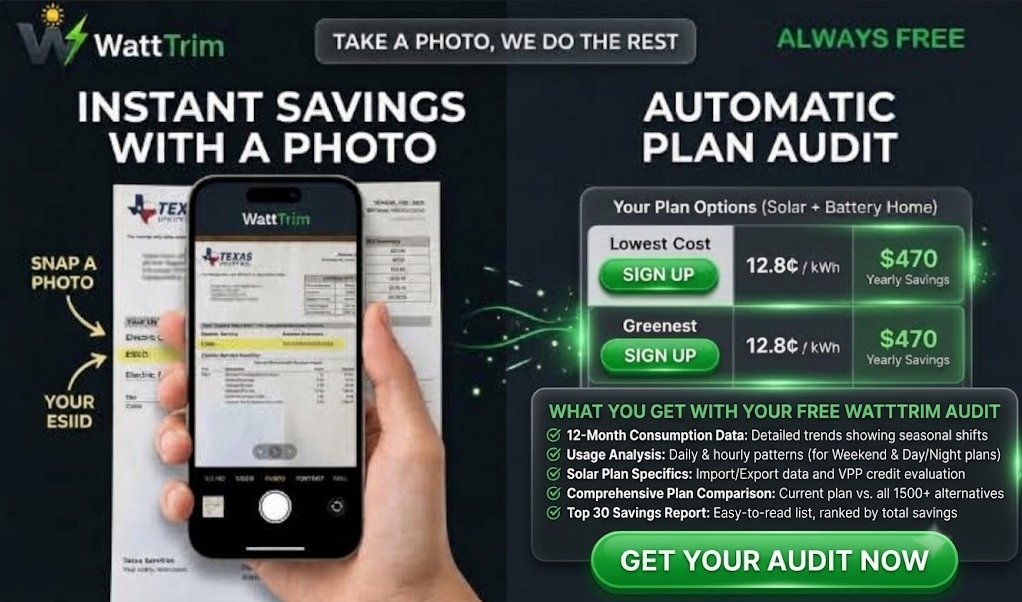
Key Considerations Before You Sign
Your TDU and interconnection
Texas has six TDUs: CenterPoint in the Houston area, Oncor across Dallas/Fort Worth and much of North and West Texas, AEP Texas Central and AEP Texas North, TNMP, and Lubbock Power and Light (LP&L). The TDU owns the poles, wires, and meter at your home, and it controls the interconnection process for any equipment that can send power to the grid.
Interconnection requirements, paperwork, and approval timelines differ between TDUs. CenterPoint requires a lockable AC disconnect switch within 10 feet of the meter. Oncor enforces specific placard guidelines. Some VPP programs are not offered in every TDU area, and LP&L is in a unique position because Lubbock has different retail choice arrangements than the rest of ERCOT. Check that the program serves your TDU, and ask the provider whether your battery's interconnection approval is already in place or still needed. For installers who handle this paperwork, see the Texas solar and battery installer directory.
What happens to your solar buyback credit
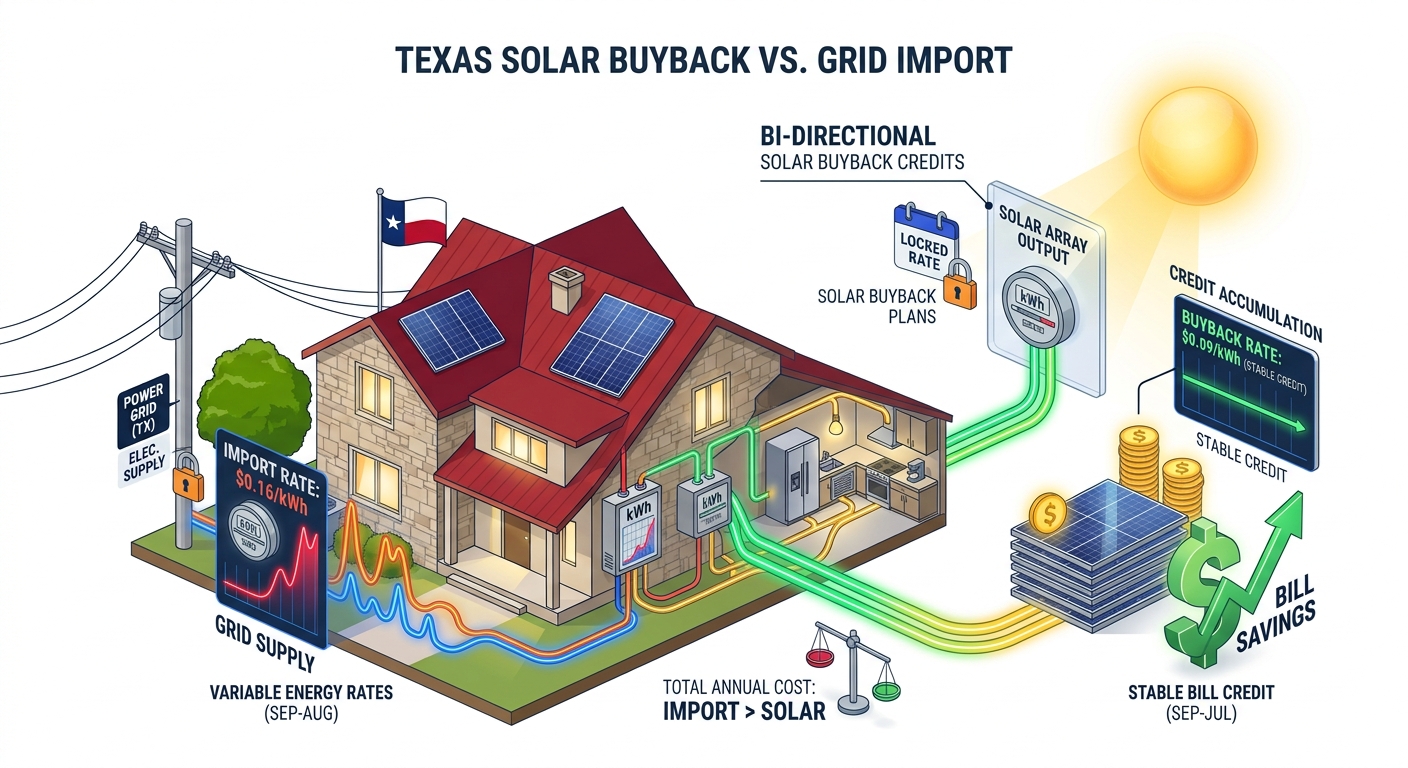
This is the consideration homeowners miss most often. Because a VPP is tied to a retail plan, enrolling usually means moving off your current REP. If you currently receive a solar buyback credit from that REP, you may lose it, or the new plan may value your exported solar differently. Your net result depends on how much solar you export, when you export it, and what the new plan pays for it.
Do not compare only the VPP payout. Compare your total annual cost: energy charges, delivery charges, base fees, buyback credit, and VPP income together. Our guide to comparing solar buyback plans in Texas walks through that comparison, and the solar buyback plan comparison page lets you see current options side by side.
Smart Meter verification
VPPs measure what your battery does using your Smart Meter. Smart Meter Texas records electricity data in 15-minute intervals, and that interval data is what lets a provider confirm how much energy you imported and exported during a given event. This means your meter needs to be working correctly and reporting reliably, and your provider needs permission to access your data.
It is also useful for you. The same 15-minute data shows when you use power, when you export, and how much a battery could realistically shift. Reviewing it before you enroll is the best way to judge whether a given program's earnings mechanism fits your pattern. WattTrim's free audit analyzes your actual Smart Meter data to show how your usage breaks down across peak and off-peak hours, and how VPP plans compare against every other option available in your area. Trim My Bill to see where you stand.
Contract terms and fine print
VPP programs are new, and terms evolve. Before enrolling, ask about:
- The contract length and any early termination fee
- Whether rates are fixed or variable, and for how long
- The minimum backup reserve and who controls it
- How many events per year the program may call, and for how long each
- How payouts or credits appear on your bill, and when
- What happens to the arrangement if you sell your home or replace your battery
- Any limit on how many batteries or how much capacity qualifies
Co-op and Municipal Programs
Not all Texas VPP activity happens in the deregulated ERCOT retail market. Several cooperatives and municipal utilities run their own battery programs:
- CoServ PeakTime Perks - Tesla Powerwall-specific co-op program
- GVEC Peak-Time Payback - Supports Tesla Powerwall and Enphase IQ systems
- CPS Energy My Battery Rewards - San Antonio municipal utility, per-event credits
- Austin Energy Power Partner Battery Pilot - Launched March 2026, $500 upfront incentive plus annual incentives above $300
- Bandera Electric Cooperative - Customer DER aggregation
How to Evaluate Which VPP Model Fits You
Start with what you already own, then work through the questions below.
1. What battery do you have, or plan to buy?
If you have a Powerwall, your realistic choices are Tesla Electric (Fixed for guaranteed credits or Dynamic for market upside) and David Energy.
If you have Enphase IQ or SolarEdge Energy Bank, look at Octopus Energy, Reliant, TXU Energy, and David Energy.
If you have a Qcells Q.HOME battery and are already a Chariot customer, their Battery Rewards add-on stacks with your existing buyback credits.
If you have LG RESU with a SolarEdge inverter, Reliant is your option.
If you have no battery and do not want to buy one outright, Base Power's hardware-as-a-service model is the one to consider.
If you are shopping for a battery, remember that the brand narrows your VPP options for years, so factor that into the purchase.
2. Do you want predictable income or market upside?
Octopus's fixed monthly credit, Reliant's flat $50/month, and Tesla Electric Fixed's $400/year per battery give you numbers you can plan around.
David Energy's 90 percent pass-through and Tesla Electric Dynamic's wholesale export rate offer more upside in a volatile year and less certainty in a calm one. Neither approach is better in every situation. It depends on your tolerance for variability.
3. How much outage protection do you need?
If a long outage would be a serious problem, such as medical equipment, work from home, or a household with young children or elderly relatives, prioritize a program with a high, guaranteed reserve.
Remember that every percentage point of reserve you hold is energy not available for dispatch. The Winter Storm Uri experience in 2021 is a reminder of why many Texans bought batteries in the first place.
4. What is your total annual cost?
Add up everything. A VPP that pays well but comes with a higher base rate or a lower solar buyback credit can leave you no better off than your current plan. Use your actual 12 months of Smart Meter data, not averages.
5. How do you feel about the contract?
Look at term length, fees, and flexibility. A shorter commitment lets you switch if the market changes.
If you want help sizing your system, WattTrim's free Solar Study uses your Smart Meter data to estimate how many panels and batteries would cover your usage and how storage might fit your situation. You can also compare retail plans on the solar buyback plan comparison page.
Researching a Battery Installation? Start Here
If you do not have a battery yet and are exploring VPP options as part of your purchase decision, the brand you choose will lock you into a specific set of programs for years. A Powerwall limits you to Tesla Electric and David Energy. An Enphase IQ system opens up Octopus, Reliant, TXU, and David Energy. A Qcells Q.HOME battery pairs with Chariot Energy's Battery Rewards. Base Power sidesteps the question entirely by providing their own hardware.
Before committing, WattTrim's free Solar Study can analyze your actual Smart Meter import and export data to help you understand how much energy you are producing, how much you are sending back, and how a battery could shift that balance. That information makes it much easier to evaluate whether a VPP program's compensation model would pay off for your specific household.
You can also browse the Texas solar and battery installer directory to find qualified installers in your area.
A VPP Plan Is Not Always the Best Plan
It is worth stating directly: a VPP plan is not automatically the best financial choice for every battery owner. VPP programs bundle a retail electricity plan with a dispatch agreement, and the retail side of that bundle, including the energy rate, buyback credit, and base fees, may not be the most competitive option for your consumption pattern.
A homeowner with modest exports and high daytime usage might save more on a straightforward low-rate plan than on a VPP plan that pays a monthly battery credit but charges a higher energy rate. The VPP income can look attractive in isolation, but the total annual cost is what matters.
This is why running an actual comparison matters. WattTrim's free audit compares VPP plans against every other option available in your area using your real Smart Meter data, not estimates. If a non-VPP plan saves you more, the results will show that. Trim My Bill to see where you stand.
Bottom Line
The Texas VPP landscape is growing, with nine REP-linked programs and several co-op and municipal options. But the options are shaped by hardware more than anything else. Tesla Electric serves Powerwall owners with two plan types: Fixed for guaranteed per-battery credits or Dynamic for wholesale market exposure. Octopus, Reliant, and TXU serve Enphase and SolarEdge owners. Chariot Energy serves Qcells battery owners. David Energy spans several brands. Base Power and the sonnen/Abundance partnership provide their own equipment.
None of these is the right answer for everyone. Match the program to your battery, your tolerance for variable income, your backup needs, and your total electricity cost. And because terms change frequently, confirm every detail directly with the provider before you enroll.
Put This Knowledge to Work
Compare your current plan against 1,500+ options across all 6 Texas TDU service areas, including exclusive broker-negotiated rates not found on PowerToChoose.org. Always free.
Trim My BillFrequently Asked Questions
What is a virtual power plant in Texas?
A virtual power plant is a group of home batteries coordinated by software so they act like a single power plant. When the ERCOT grid is stressed and wholesale prices are high, the software sends stored energy from participating batteries to the grid, and the homeowners are compensated through bill credits or payouts, depending on the program.
Which VPP programs can I join with a Tesla Powerwall?
Tesla Electric is built for Powerwall owners and supports Powerwall 2, Powerwall+, and Powerwall 3. David Energy also supports Powerwall. Compare how each pays you and how much control you keep over your backup reserve, and verify current eligibility with each provider.
What if I have an Enphase IQ or SolarEdge battery?
You have the most options. Octopus Energy, Reliant (Battery Perks), TXU Energy (Battery Rewards), and David Energy all support Enphase IQ batteries. Octopus and Reliant also support SolarEdge Energy Bank. Reliant additionally supports LG batteries when connected to a SolarEdge inverter. Compare their different compensation models: Octopus pays per kWh of capacity, Reliant pays a flat $50/month, and David passes through wholesale prices.
I have a Tesla battery with a SolarEdge (or other non-Tesla) solar inverter. Which programs can I use?
This is a common setup. As long as a Tesla Gateway manages your Powerwall (which is standard even when paired with non-Tesla solar equipment), Tesla Electric's VPP can communicate with and dispatch your battery. The SolarEdge inverter handles solar production; the Tesla Gateway handles battery control. You can choose between Tesla's Fixed plan ($400/year per Powerwall credit) or Dynamic plan (90% wholesale export). David Energy also supports Powerwall in this configuration. Verify your specific setup with the provider before enrolling.
Will joining a VPP affect my solar buyback credit?
It can. VPP programs are generally tied to a retail electricity plan, so joining one often means switching providers. Your current solar buyback credit may not carry over, or the new plan may value your exports differently. Compare your total annual cost, including delivery charges, base fees, buyback credits, and VPP income, before switching.
Can a VPP guarantee how much I will earn?
No. Fixed-credit programs like Octopus Energy and Reliant are more predictable, but the total still depends on program terms and your battery's capacity. Market-based programs depend on how often ERCOT prices spike, which can reach $5,000 per megawatt-hour during grid events but may not happen at all in a mild year. Be cautious of anyone who promises a specific dollar amount.
Does my utility or Smart Meter matter for VPP enrollment?
Yes. Texas has six TDUs, including CenterPoint, Oncor, AEP Texas Central, AEP Texas North, TNMP, and LP&L, and interconnection requirements and timelines differ between them. Some VPP programs are not available in every service area. Smart Meter Texas records 15-minute interval data, which providers use to verify your battery's activity. Confirm that the program serves your TDU area and that your meter data access is set up.
Is a VPP plan always the best choice for battery owners?
No. A VPP plan bundles a retail electricity plan with a battery dispatch agreement, and the retail side of that bundle may not be the most competitive option for your usage pattern. If a VPP plan charges a higher energy rate or offers a lower solar buyback credit than alternatives, the battery income might not make up the difference. Always compare your total annual cost, including energy charges, delivery, fees, buyback credits, and VPP income, against non-VPP plans. WattTrim's free audit runs that comparison using your actual Smart Meter data.
Can I stack VPP credits with solar buyback credits?
It depends on the provider. Chariot Energy's Battery Rewards is explicitly designed to stack: you receive both your existing solar buyback credits and the $40/month battery credit on the same bill. Other programs may replace your current buyback arrangement entirely because they require you to switch to a new retail plan. Always compare your total annual cost before and after, including energy charges, delivery, buyback credits, and VPP income.
What if I do not own a battery yet?
Base Power offers a hardware-as-a-service model where they install and own the battery at your home for a monthly membership fee. This lets you participate in grid dispatch and get backup power without the upfront cost of purchasing a battery. If you are considering buying your own battery, the brand you choose will determine which VPP programs you can access in the future, so research compatibility before purchasing. Browse the Texas solar and battery installer directory to find qualified installers in your area.