Predatory Solar Practices in 2026: A Texas Homeowner's Guide to Avoiding Costly Deals

Solar can be a good investment for a Texas home. A properly sized system, a transparent cash or loan price, and a realistic plan for electricity you still must buy can reduce long-term costs. But solar is not automatically a savings product, and the industry has a documented predatory underbelly. The direct answer is simple: do not sign a Texas solar contract until you have the full cash price, the full financed price, the annual production estimate, the electricity-rate assumptions, the utility buyback terms, and the cancellation deadline in writing. A low monthly payment or a promise of "free solar" is not proof of savings. It can conceal a lease, a power purchase agreement, a large financing fee, an escalating payment, or an oversized system whose excess production earns far less than the electricity it offsets.
The Anatomy of a High-Pressure Pitch
Predatory solar sales often start with a true premise and then stretch it beyond recognition. Texas has powerful sun. Federal incentives can be valuable. Some retail electricity plans pay for exported solar electricity. Those facts do not establish that a particular system, price, loan, or buyback plan is right for your home.
"Free solar" is usually not free
When a representative says the government is providing free panels, stop and ask what you will own and what you will owe. In many cases, the proposal is a lease or a power purchase agreement, commonly called a PPA. Under a lease, a company owns the equipment and you make a monthly equipment payment. Under a PPA, a company owns the system and you agree to buy the electricity it produces at a stated rate.
Neither arrangement is inherently improper. They may make sense for a homeowner who cannot or does not want to purchase a system. But calling either one a government program or "free solar" is misleading. You may still pay for 20 or 25 years, accept annual price increases, and face important restrictions when selling the house. The company that owns the system, not the homeowner, generally claims the federal residential clean-energy credit.
Ask for the exact transaction type in the first paragraph of the agreement: cash purchase, installment loan, lease, or PPA. Then ask who owns the system, who receives the tax credit, who maintains the equipment, and what happens if you sell or refinance. If the salesperson cannot give a direct answer, that is a reason to pause.
Tax-credit math is not a discount at closing
The federal Residential Clean Energy Credit under Internal Revenue Code Section 25D can equal 30 percent of eligible costs for a qualifying homeowner and qualifying installation, subject to the rules in effect for the applicable tax year. It is a nonrefundable income-tax credit. It is not a 30 percent reduction in your loan balance, a utility rebate, or a guaranteed cash payment from the government.
A homeowner needs enough federal income-tax liability to use a nonrefundable credit in a given year, although unused eligible credit may be carried forward under current rules. The credit does not create a refund beyond tax liability merely because a salesperson placed a number in a spreadsheet. Renters, lessees, and PPA customers ordinarily do not claim the credit because they do not own the equipment. Consider a $40,000 purchase. A presentation may show a $12,000 credit and call the system "really $28,000." That is only a planning estimate, not a $12,000 invoice reduction. If the buyer has $4,000 of federal income-tax liability in the relevant year, the buyer may use only that amount that year and must determine whether and when the remaining eligible credit can be used. A buyer should consult a qualified tax professional, rather than let a commissioned salesperson determine tax eligibility.
Be especially skeptical of a loan that assumes the 30 percent credit will be paid back into the loan after 18 months. Some loans reset to a much higher payment if that voluntary prepayment does not occur. Ask for both payment schedules, one assuming the tax-credit prepayment and one assuming it never happens.
Phantom savings begin with bad inputs
A proposal based only on aerial imagery can miss roof condition, shade, structural limits, panel locations, or the condition of an electrical panel.
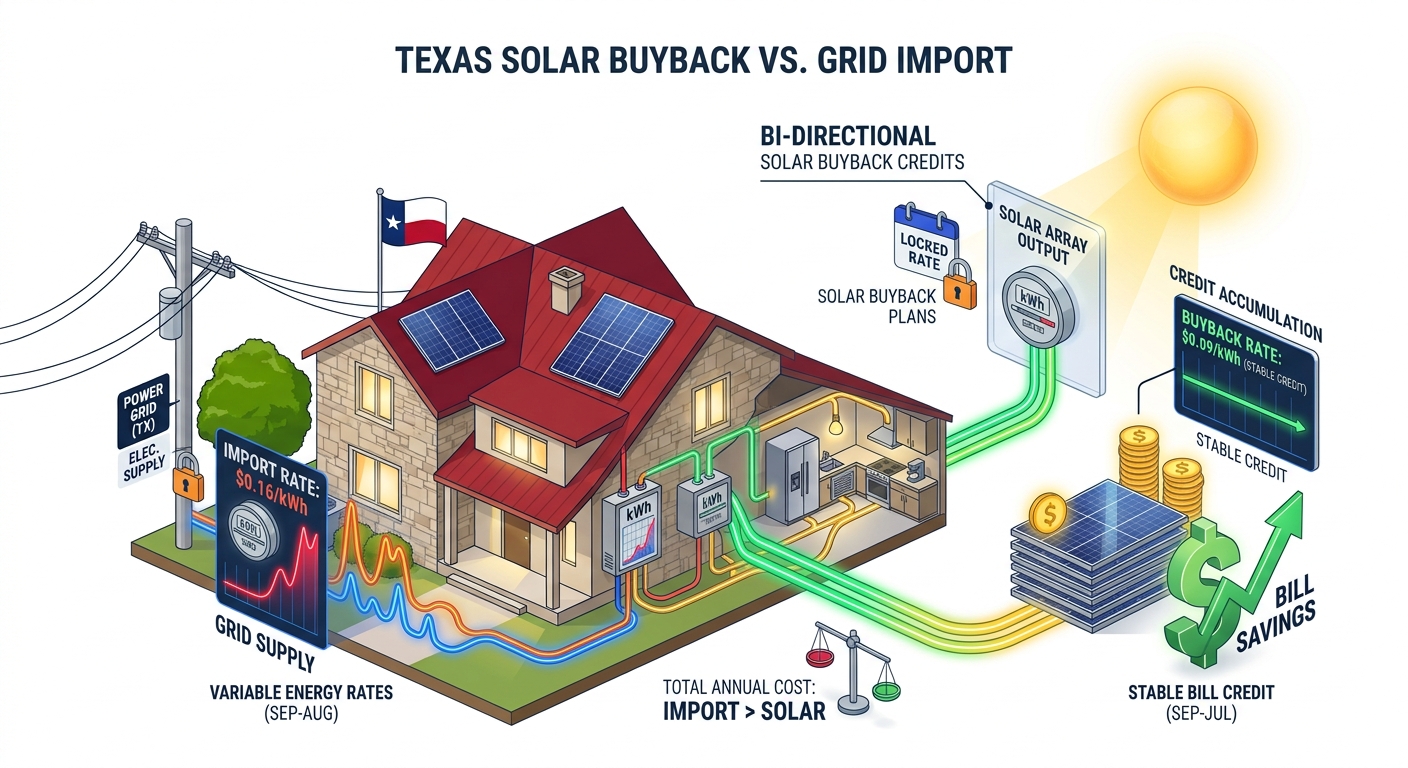
It can also use the wrong electricity baseline. A homeowner who uses 19,000 kWh per year should not accept a savings model based on a generic 12,000 kWh Texas household. The relevant starting point is 12 months of actual bills, including monthly kWh use, delivery charges, rate changes, and your current retail electric plan. A sales projection may also assume that every solar kWh has the same value as a retail kWh. In Texas, that is often not true. Your avoided purchase price can include energy and delivery components, while exported power may be compensated at a lower rate, subject to plan terms, caps, or monthly changes. A system designed to produce far more than on-site use can look impressive in annual kWh but deliver disappointing cash savings.
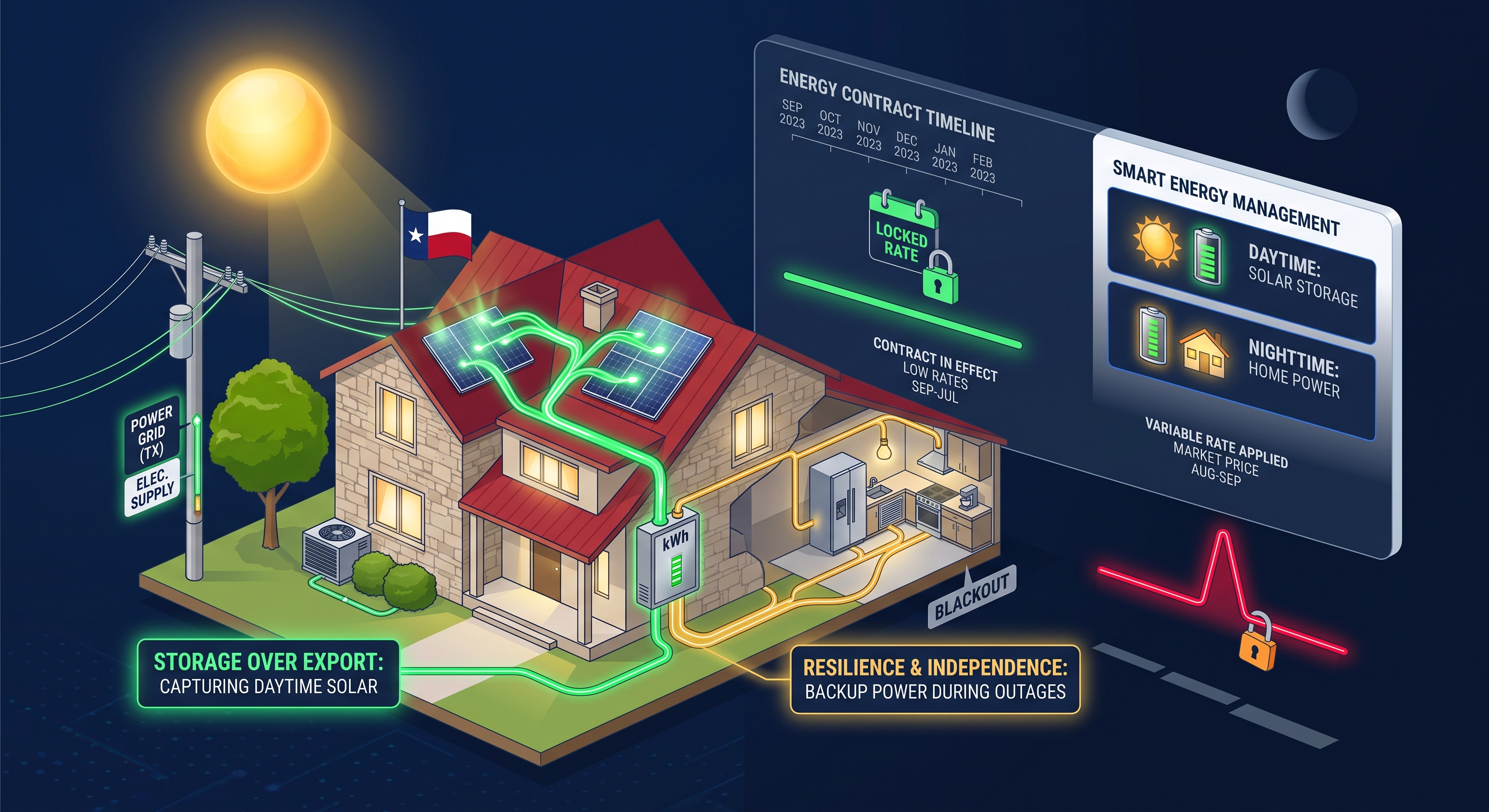
Require the estimator to state the annual kWh production, the degradation assumption, the first-year self-consumption assumption, the exported-kWh assumption, the retail rate used, the buyback rate used, and every future rate escalation assumption. Do not accept "offset" as a synonym for "eliminates your bill." A grid-connected home normally retains fixed charges, and solar production does not cover nighttime consumption unless storage and the applicable plan economics support it.
The Hidden Financial Mechanics
The most costly solar problem is often not a defective panel. It is a financing structure that makes a reasonable installation look affordable by hiding a large markup inside the principal.
The price you finance may not be the price of the system
The Consumer Financial Protection Bureau has warned that some solar-specific loans include dealer fees or other markups that increase principal by 30 percent or more above the cash price. A dealer fee can compensate a lender or finance platform for offering a promotional interest rate. It may be paid by the installer, but it is frequently built into the homeowner's financed price.
Here is the basic economic effect:
| Cost item | Amount |
|---|---|
| True Equipment and Install Cost | $32,000 |
| Hidden "Dealer Fee" (20-30%) | +$9,600 added directly to principal |
| Total Financed Amount | $41,600 |
| Result | Homeowner pays interest on $41,600 over 20-25 years |
A 3.99 percent advertised APR can be real, but it does not tell the full story when a 20 to 35 percent dealer fee was added to the principal without clear itemization. In this example, financing $41,600 rather than paying the $32,000 cash price means interest accrues on an additional $9,600. The customer cannot evaluate the loan honestly unless the contract separates the cash system price, loan principal, dealer fee or lender compensation, APR, term, payment, and total of payments.
For illustration, a 25-year $41,600 loan at 3.99 percent has a payment of about $220 per month and total scheduled payments of roughly $66,000. The exact figure depends on the contract. The key point is that the lower stated rate can coexist with a much higher starting balance. A homeowner should compare that offer with a transparent cash quote and, if financing is desired, an independent loan quote using the cash price.
Do not confuse disclosure with understanding. Truth in Lending disclosures are important, but the right question is still: "What would you charge if I paid cash, and what exact amount is being added because I selected this loan?" Request the answer in writing before authorizing a credit application.
Escalators can outrun the promise
Lease and PPA offers often emphasize a first-month payment, such as $130. The more important figure may be in the escalation clause. A 2.9 percent annual escalator raises that $130 monthly payment to about $229 in year 20. A 3.9 percent escalator raises it to about $279 in year 20. Those are recurring monthly obligations, not one-time fees.
An escalator may be acceptable only if you understand the risk and have compared it with your realistic alternative. Texas retail electricity prices do not rise at a fixed 2.9 or 3.9 percent every year. They vary by market conditions, contract choices, weather, fuel costs, delivery charges, and regulation. A PPA payment can increase even in periods when your utility rate is flat or lower. It can also increase while production declines modestly over time.
Ask for a year-by-year schedule showing the monthly payment, annual payment, production estimate, price per kWh under the PPA if applicable, and total payment over the full term. Then compare it to a conservative utility-cost scenario, not a sales deck that assumes a single aggressive utility inflation rate for 25 years.
A UCC-1 filing can matter at sale time
A lender or solar provider may file a UCC-1 financing statement to give public notice of a security interest in financed equipment. In some transactions it is filed as a fixture filing connected to the property. It can cloud a title search, complicate refinancing, and create a last-minute problem when you sell.
A buyer, title company, or buyer's lender may require the filing to be released. If the solar agreement cannot be transferred on acceptable terms, a seller may need to pay a $40,000 or larger remaining balance, negotiate a transfer, or delay the closing. That is why this question belongs before signing, not after listing the home.
Ask whether any UCC-1 will be filed, who will file it, whether it is a fixture filing, where it will be recorded, what the release procedure is, how long release takes after payoff, and what happens during a sale or refinance. Obtain the answer and any transfer policy in writing before you commit.
Regulatory Realities and Legal Protections
Legal rights are meaningful, but deadlines are short and coverage depends on the transaction. Preserve the proposal, contract, text messages, advertising, utility bills, inspection documents, and all emails. If you cancel, send written notice by a method you can prove and keep copies.
Federal protections
The FTC Cooling-Off Rule provides a three-business-day cancellation right for certain sales of $25 or more made at a consumer's home, workplace, or temporary location. It is particularly relevant to door-to-door solar sales. It is not a universal three-day right for every solar transaction, and the rule has exceptions. Do not assume it applies without reading the contract and the rule's requirements.
Federal credit disclosures under the Truth in Lending Act can help a consumer understand the amount financed, finance charge, APR, payment schedule, and total payments. The FTC Holder Rule can also preserve a buyer's ability to assert certain claims and defenses against a holder of consumer credit that the seller arranged, subject to the rule and the transaction documents. That is not a substitute for preventing a bad deal, and it is not a guarantee that a lender will simply cancel a loan after installation.
The CFPB has specifically identified solar financing risks including hidden dealer fees, misleading tax-credit representations, and payment increases tied to assumed tax-credit prepayments. Consumers can submit complaints about consumer financial products to the CFPB.
Texas-specific protections
Texas Senate Bill 1036, or SB 1036, effective September 1, 2025, created Occupations Code Chapter 1806, the Residential Solar Retailer Regulatory Act. It requires residential solar retailers and compensated solar salespeople to register, with specified exceptions for certain electrical contractors and their employees. A homeowner can ask for the retailer's and salesperson's registration numbers. The agreement must include the retailer's and involved salesperson's registration numbers, or the electrical contractor's name and license number where the contractor exemption applies.
The law requires agreements for an installation at a residence to identify the electrical contractor and license number, or a selection list, and to provide that permits and required utility or cooperative interconnection approval will be obtained. It also requires a five-business-day cancellation period for a buyer or lessee. The contract must state the last calendar date to cancel and provide a mailing or email address for written notice. This Texas protection is broader in time than the FTC's three-business-day rule, but act immediately rather than waiting until the fifth day.
Chapter 1806 prohibits intentionally, knowingly, or recklessly making false, misleading, or deceptive oral or written statements. It also prohibits falsely stating or implying an affiliation with a public utility or government agency, ignoring posted no-soliciting signs, and allowing installation by someone who is not an electrical contractor. The Texas Department of Licensing and Regulation administers the chapter. The law permits administrative penalties and, after notice and hearing, can permit cancellation and a refund of amounts paid under the agreement.
Texas homeowners may also have remedies under the Texas Deceptive Trade Practices Act, commonly called the DTPA, depending on the facts. It can provide economic damages and other relief in appropriate cases. Deadlines, notice requirements, causation, and available damages are fact-specific. Speak with a qualified Texas consumer attorney promptly if a seller made material false claims.
What PUCT does, and does not, regulate
The Public Utility Commission of Texas, or PUCT, oversees much of the electric market and retail electric providers in competitive Texas areas. It has a role in the educational materials required under Chapter 1806 and regulates retail electricity providers and utility-related rules within its jurisdiction. That matters because a solar owner's expected value depends heavily on interconnection and the retail plan's solar buyback terms.
PUCT oversight does not mean the PUCT approves a salesperson's savings projection or guarantees a buyback plan for 25 years. A retail plan can expire, and a homeowner may need a new plan with different export terms. Confirm your provider's interconnection requirements and current buyback plan before installing, then review the plan at every contract renewal.
The Consumer Protection Checklist
- Demand the cash price and financed price. Ask for an itemized cash purchase price, principal amount, every dealer, platform, or financing fee, APR, term, payment schedule, and total of payments. A refusal to disclose the cash price is a major warning sign.
- Verify registration, licensing, and labor. Ask for the solar retailer and salesperson registration numbers under Chapter 1806. Ask which electrical contractor will install the system, its Texas license number, whether labor is in-house or subcontracted, and who remains responsible for warranty work.
- Cross-check the model against 12 months of actual bills. Provide the estimator every monthly bill, not only a high summer bill. Require a production model that separates on-site use from exports and shows how many kWh are expected to be purchased from the grid.
- Confirm buyback assumptions with a real plan. Obtain the current electricity facts label and terms for the plan used in the model. Identify the export rate, caps, billing treatment, contract term, and whether delivery charges still apply. Do not accept a generic claim that "Texas pays you for solar."
- Read the escalator. For a lease or PPA, calculate the payment in years 1, 5, 10, 15, 20, and the final year. Ask for total payments over the entire agreement and compare them against a conservative utility-cost forecast.
- Check for UCC-1 filings before signing. Request the proposed filing language and written payoff, transfer, and release procedures. Have a title company or real-estate attorney explain implications if you plan to sell or refinance within the system term.
- Get at least three quotes. Compare system size in kW, estimated annual kWh, equipment, workmanship warranty, roof work, cash price, financing structure, battery capacity, and contract terms. The lowest monthly payment is not necessarily the lowest cost.
- Use the cancellation period deliberately. Mark the exact Texas cancellation deadline in your calendar. During that period, read every attachment, run independent comparisons, and cancel in writing if the documents differ from the pitch. Do not let a salesperson tell you that a permit application or loan approval erases your right to cancel.
Not All Installers Are the Same
It is important to recognize that many solar and battery installers operate with integrity, provide accurate estimates, use licensed electricians, and stand behind their work for years. The predatory practices described in this article do not represent the entire industry.
One of the most reliable ways to find a trustworthy installer is to start local. A company rooted in your community has a reputation to protect and is far less likely to disappear after installation. Local installers typically perform on-site inspections rather than relying solely on satellite imagery. They understand regional building codes, permitting requirements, and the specific TDU interconnection process for your area.
Large statewide or nationwide operations often rely on door-to-door sales teams with high turnover. The person who pitches you may have no long-term connection to the company, the installation crew, or the warranty process. That disconnect is where many of the worst experiences originate.
When evaluating an installer, ask how long they have served your area, whether their crews are employees or subcontractors, and how warranty service is handled locally. Check reviews from homeowners in your city or county, not just statewide testimonials. A strong local track record is worth more than a national brand name.
How WattTrim Helps
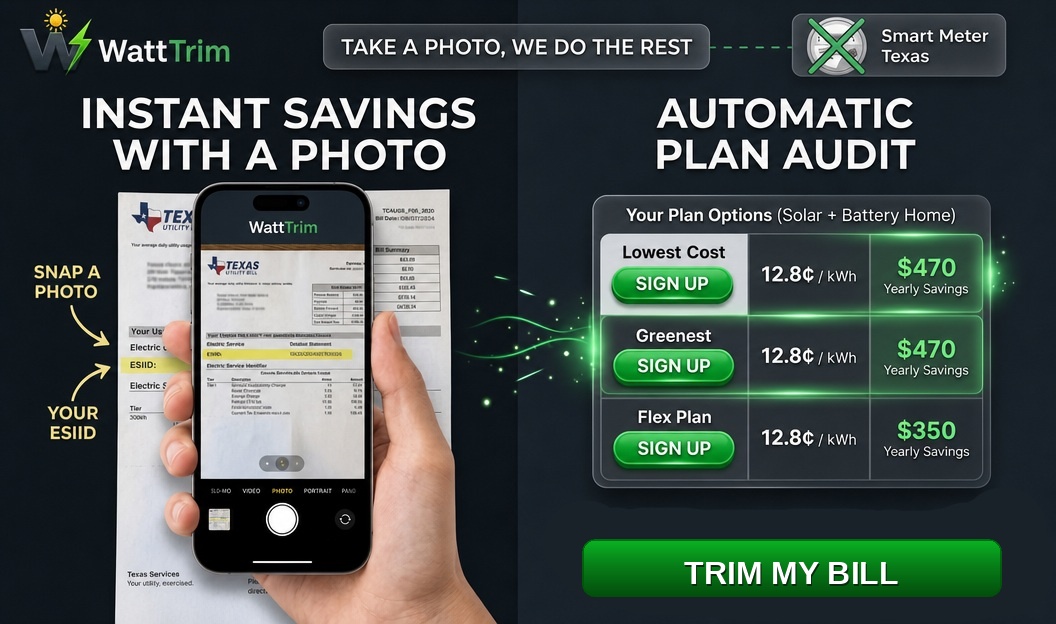
WattTrim approaches solar from the homeowner's electricity data, not from a sales quota. Our free Solar Study analyzes actual usage data and real buyback rates, not sales projections. It also helps Texas homeowners compare solar buyback plans across all 6 Texas TDU areas. That comparison is essential because a system's financial result depends not only on panel output, but also on what you pay for grid power and what your plan pays for exports.

Use an independent analysis before you sign. The goal is not to force every home into solar. The goal is to identify a system size, purchase structure, and retail electricity plan that can stand up to the numbers.
Put This Knowledge to Work
Compare your current plan against 1,500+ options across all 6 Texas TDU service areas, including exclusive broker-negotiated rates not found on PowerToChoose.org. Always free.
Trim My BillFrequently Asked Questions
How can I spot a predatory solar deal?
Look for urgency, a "free solar" claim without a clear ownership explanation, a refusal to provide a cash price, tax-credit promises presented as guaranteed cash, unexplained dealer fees, a lease or PPA escalator, and savings estimates that do not use 12 months of your bills. A credible proposal identifies the system owner, lender, cash price, estimated annual kWh, retail-rate assumption, buyback-rate assumption, and all cancellation terms.
Are solar leases worth it in Texas?
They can be suitable for some homeowners, but they require a different analysis from owning a system. You generally do not receive the ownership tax credit, and you must evaluate the payment escalator, transfer rules, buyout options, production guarantees, and current buyback economics. Compare the full term of the lease or PPA against a cash purchase, a transparent loan, and the cost of remaining a utility customer.
What is a dealer fee in solar financing?
A dealer fee is a charge connected to arranging a loan, often used to support a lower advertised interest rate. It can be built into the loan principal instead of listed as a separate line item. For example, a $32,000 system with a 30 percent fee can become a $41,600 loan. Always compare the cash price, principal, APR, term, and total of payments.
Can I cancel a solar contract after signing in Texas?
For agreements covered by Texas Occupations Code Chapter 1806, a buyer or lessee has until the fifth business day after signing to cancel by written notice without penalty or further obligation. The agreement must state the final cancellation date and a mailing or email address. Certain door-to-door transactions may also be covered by the FTC's three-business-day Cooling-Off Rule. Act immediately, follow the written notice instructions, and keep proof of delivery.
What is a UCC-1 filing on solar panels?
A UCC-1 financing statement is public notice that a lender or solar provider claims a security interest in financed equipment. Depending on the transaction, it may be filed as a fixture filing related to the property. It can affect a title search, sale, or refinance until it is released. Ask for the filing, payoff, transfer, and release procedures before signing.
Does Texas regulate solar sales?
Yes. Senate Bill 1036 created Texas Occupations Code Chapter 1806, effective September 1, 2025. It requires registration for covered residential solar retailers and compensated salespeople, imposes contract and cancellation requirements, and prohibits false or misleading statements and false government or utility affiliation claims. The Texas Department of Licensing and Regulation administers the law, while the PUCT regulates relevant electricity-market matters.
How do I verify a solar savings claim?
Start with 12 months of your own bills. Ask for annual production in kWh, panel orientation and shade assumptions, system degradation, self-consumption and export assumptions, retail price, delivery-charge treatment, and the exact buyback plan. Calculate a conservative case using a lower export value and a different future utility-rate path. If the salesperson will not provide the assumptions, the claim is not verifiable.
What questions should I ask a solar salesperson?
Ask: What is the cash price? What is the financed principal and every fee? Who owns the system? Who gets the tax credit? What is my payment in every year of the contract? What happens if I sell? Will you file a UCC-1? Which electrical contractor installs it? What are your registration and license numbers? What are the current buyback-plan terms? What is the exact cancellation deadline? Insist on written answers before you sign.