# Best Way to Compare Solar Buyback Plans in Texas
The best way to compare Texas solar buyback plans is to look beyond the advertised export rate and calculate the full all-in cost using your actual monthly production and consumption data, since base charges, minimum usage fees, and how the buyback rate is structured can outweigh a headline number. A plan with a lower export rate but a lower base charge can end up cheaper overall than a plan advertising a higher buyback rate.
What Solar Buyback Plans Are
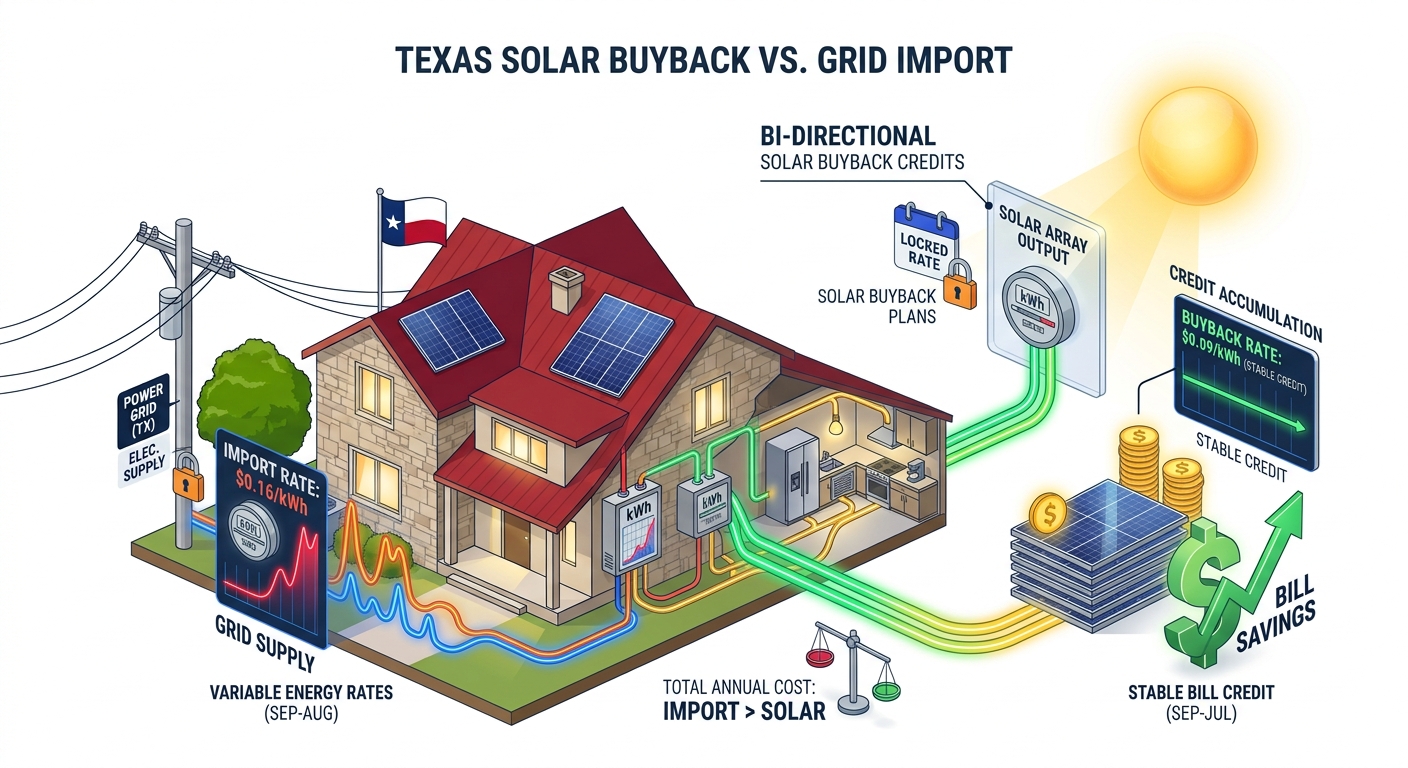
A solar buyback plan is a retail electricity plan designed for homes with a rooftop or ground-mounted solar system already installed. Instead of net metering in the traditional sense, most Texas Retail Electric Providers (REPs) credit you for the electricity your system exports back to the grid at a specified buyback rate, while you continue to pay for the electricity you import from the grid at the plans regular usage rate. Your local transmission and distribution utility (TDU), such as Oncor, CenterPoint, AEP Central, AEP North, TNMP, or LP&L, still delivers the physical power and charges its own separate, regulated delivery fees regardless of which REP you choose.
Types of Solar Buyback Structures
Fixed Buyback Rate
The REP pays a flat, stated rate per kWh for every unit of solar energy you export, regardless of time of day or wholesale market conditions. This structure is the easiest to understand and to compare directly against a stated cents-per-kWh number.
Retail-Rate Credit
Some plans credit exported energy at or near the same rate you pay for imported energy, effectively giving you a dollar-for-dollar style offset. This can be more valuable than a fixed buyback rate if your consumption rate is relatively high, but it is less common and often paired with a higher base charge or minimum usage fee.
Wholesale-Indexed Buyback
The export credit floats with real-time or day-ahead ERCOT wholesale market prices rather than a fixed number. This can produce higher credits during high-demand periods, but it also introduces volatility and requires more careful monitoring, since a low-price hour can mean a very small credit for that same exported energy.
Time-of-Use Solar Plans
These combine a time-of-use import rate structure with a buyback rate that may also vary by hour. They tend to suit households that both produce and consume heavily in overlapping windows, such as systems paired with a home battery that shifts self-consumption to evening hours.
Why Solar Plans Are Harder to Compare Than Standard Plans
A standard electricity plan comparison mainly involves one rate applied to one number: your monthly usage. A solar buyback comparison involves several moving parts at once:
- Export rate: what you are credited for energy sent to the grid
- Import rate: what you pay for energy pulled from the grid when your system is not producing enough
- Net metering equivalent: how the plan nets your imports against your exports over a billing cycle, since not all plans true these up the same way
- TDU passthrough charges: the regulated delivery charges that apply to your imported (and sometimes gross) usage regardless of your REP or export credits
Key Metrics to Compare
When evaluating solar buyback plans, focus on:
- Buyback rate per kWh, and whether it is fixed, indexed, or retail-matched
- Base charge, the fixed monthly fee the REP charges regardless of usage
- Minimum usage fees, which can apply if your net import falls below a certain threshold, a scenario common for well-sized solar systems in mild months
- All-in cost at different usage tiers, calculated using your real monthly import and export numbers rather than a single flat estimate
The Import and Export Balance
Your consumption pattern and your solar system size both determine how much you actually benefit from any given buyback structure. A system sized to closely match daytime household usage will export relatively little and import more in the evening, meaning the import rate and TDU delivery charges matter more than the buyback rate. A larger system that regularly exports a surplus will be far more sensitive to the buyback rate, since a larger share of the annual bill outcome depends on those export credits.
Seasonal variation matters too. Texas summer months typically bring higher production and higher household air conditioning load simultaneously, while winter production drops and import needs can rise on cold mornings and evenings. A plan comparison that only looks at one months bill can miss how these seasonal shifts change which plan performs best across a full year.

How WattTrim Analyzes Solar Production and Consumption Data
WattTrim pulls your actual interval data through Smart Meter Texas, which for solar customers can include separate import and export channels where the TDU reports them. This lets WattTrim calculate, month by month, how much energy you pulled from the grid, how much you sent back, and what each candidate plan would have actually charged and credited you based on that real history, rather than assuming a single blended usage number.
WattTrim's plan rankings are based solely on your actual usage data. Provider compensation never influences your results. For solar households specifically, this means the buyback rate is weighed against your real export volume, not a generic assumption about how much solar customers typically produce.
Solar buyback plan analysis through WattTrim is currently available in the CenterPoint and Oncor service areas, where sufficient solar interconnection data is available through Smart Meter Texas. Availability in other TDU territories is expected to expand over time. Solar customers should compare only among plans designed to support solar interconnection, since a standard non-solar plan generally will not include export crediting.
How Many Solar Buyback Plans Are Available in Texas
Texas currently has dozens of solar buyback plans available across the state's 6 TDU service areas: Oncor, CenterPoint, AEP Central, AEP North, TNMP, and LP&L. Export rates on these plans range widely, from wholesale-indexed structures that float with ERCOT market prices to fixed rates that can run above 10 cents per kWh, and base charges span from $0 to $14.95 per month depending on the plan and provider.
That spread matters because two plans advertising similar buyback rates can produce very different annual costs once base charges and minimum usage fees are factored in. GridWise Audit's plan database tracks every solar buyback plan across all 6 TDU service areas, including export rate structure, base charge, and minimum usage terms, so households can see the full set of options rather than a partial list.
What ERCOT Wholesale Prices Mean for Your Export Credits
Wholesale-indexed buyback plans tie your export credit to real-time or day-ahead ERCOT settlement prices rather than a fixed number. During peak solar production hours, roughly 10am to 4pm, ERCOT settlement prices frequently run well below the cents-per-kWh figure advertised on fixed-rate buyback plans, since that is also when the most solar generation is flowing onto the grid statewide.
This is the core tradeoff of a wholesale-indexed plan: it can produce a higher credit during scarcity events or high-demand hours, but it also introduces real volatility, since exporting during a low-price hour can mean a very small credit for that same energy.
GridWise displays real-time ERCOT settlement-based wholesale averages so you can see exactly what solar buyback credits are worth in your area. Compare solar buyback plans with transparent wholesale pricing on the Solar Plans page. A fixed export rate trades that upside away in exchange for predictability, since the rate per kWh does not change regardless of when you export. For subscribers who want to monitor this in real time, GridWise Audit tracks ERCOT settlement data continuously through its Sentinel monitoring service, flagging when wholesale-indexed credits are trending meaningfully above or below a household's plan alternatives.
Which Buyback Structure Fits Your Setup
The right buyback structure depends less on which rate is advertised as "best" and more on how your system is sized and how you use power:
- Fixed buyback rate tends to suit smaller solar systems and households that prioritize predictability over maximizing credits, since the rate per kWh exported never changes.
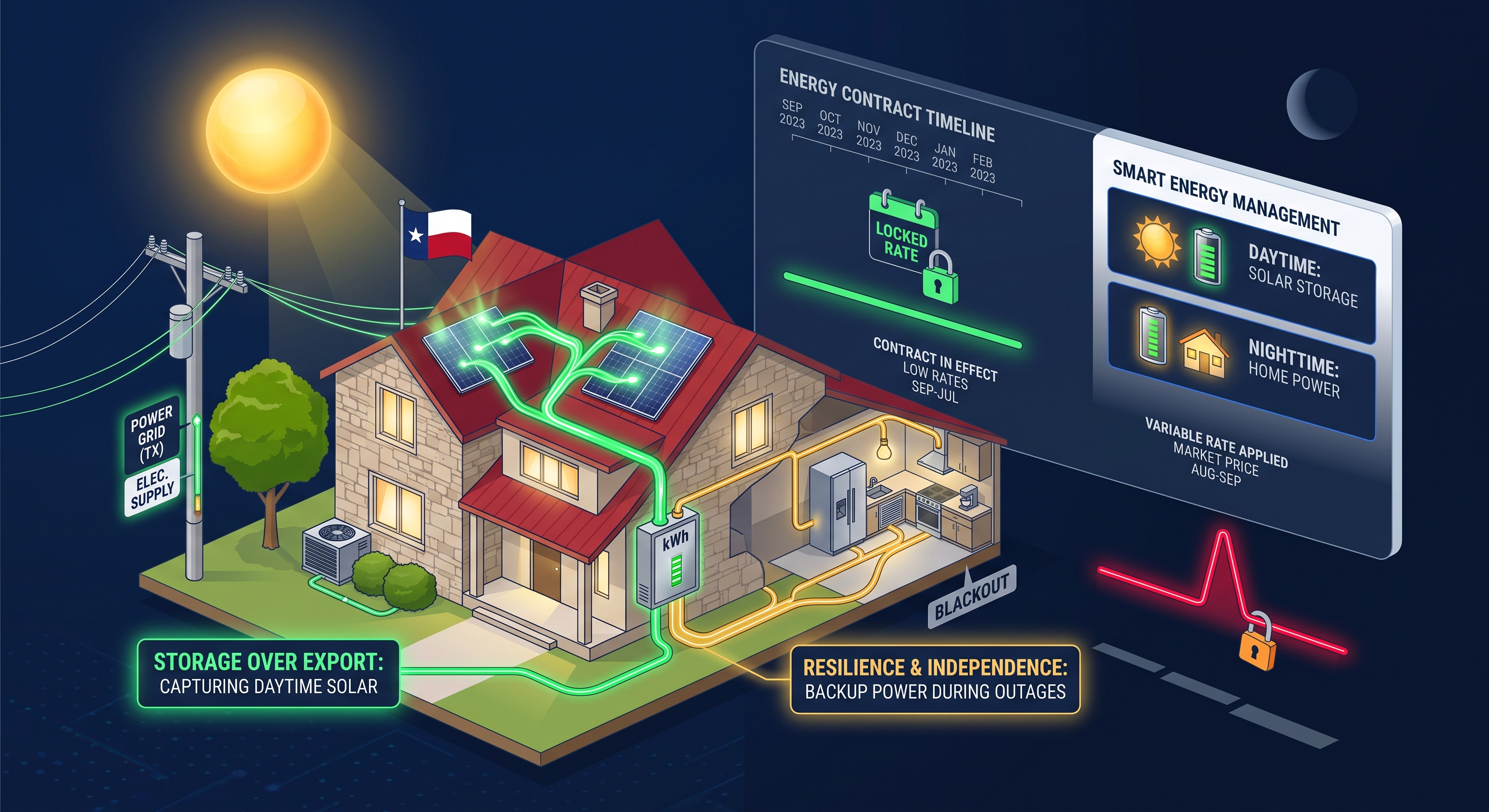
- Wholesale-indexed buyback tends to suit households with a battery, since a battery lets you hold exports back from low-price hours and release them, or avoid exporting, during periods when ERCOT prices are elevated.
- Retail-rate credit tends to suit high-consumption homes where the import rate is relatively high, since crediting exports at or near that same rate can offset more of the bill than a flat, lower buyback number would.
Solar Deep Dives
These companion articles cover every angle of the Texas solar landscape:
- Solar Buyback Plans in Texas: What You Need to Know - How buyback plans work, what to watch for, and how to find the best one for your system.
- Why a Battery, Not Just Solar Panels, Is the Real Play - With net metering gone and TOU rates rising, a home battery is the missing piece.
- The Residential Demand Charge: The Next Major Threat to Rooftop Solar - How utility demand charges are moving from commercial to residential and what it means for solar ROI.
- The Solar Bill Swap: Why Paying the Same Amount Is Still a Smart Move - Even when your solar loan payment matches your electric bill, the economics still favor owning your power.
Sources
- Public Utility Commission of Texas: puc.texas.gov
- Smart Meter Texas: smartmetertexas.com
- ERCOT: ercot.com
Put This Knowledge to Work
Compare your current plan against 1,500+ options across all 6 Texas TDU service areas, including exclusive broker-negotiated rates not found on PowerToChoose.org. Always free.
Trim My BillFrequently Asked Questions
What is the difference between a solar buyback plan and net metering?
Net metering, in the traditional utility sense, is not standard for most competitive REPs in the ERCOT market. Instead, most Texas solar customers use buyback plans, where imports and exports are billed and credited separately rather than simply netted against each other on a one-to-one basis, though the details vary by plan.
Will a higher buyback rate always save me more money?
Not necessarily. A higher buyback rate can be offset by a higher base charge, a minimum usage fee, or a higher import rate. The full all-in cost, calculated against your real production and consumption, is the more reliable comparison point.
Do TDU delivery charges apply to solar exports?
TDU delivery charges are generally based on your metered usage as reported by your utility, and the specifics of how import versus export volumes factor into delivery charges can vary. Checking your TDUs published tariff, or asking your REP directly, is the most reliable way to confirm how this applies to your account.
Can WattTrim compare solar plans everywhere in Texas?
Solar buyback plan analysis is currently available for CenterPoint and Oncor service areas. Households in AEP Central, AEP North, TNMP, or LP&L territory can still use WattTrim to compare standard, non-solar plan options.