Why a Battery - Not Just Solar Panels - Is the Real Play in 2026
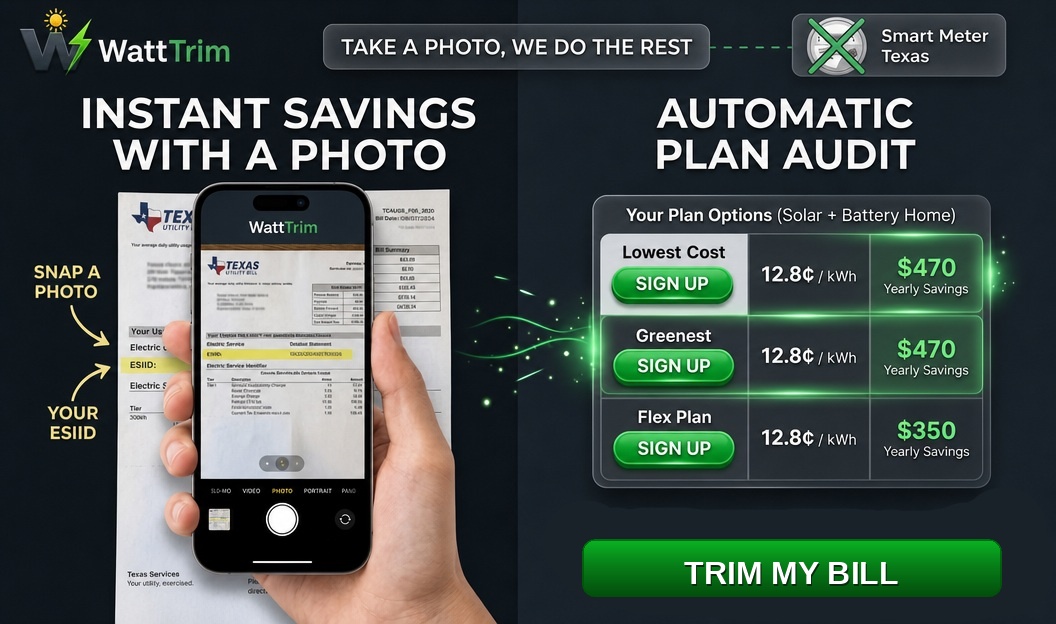
Ready to find your true lowest rate?
Snap a photo of your electricity bill and get a personalized analysis within minutes.
Solar panels alone may export surplus daytime generation at a low value and leave the home buying power during expensive evening hours, while a battery stores that generation for later self-consumption and peak shaving. Batteries can also provide outage backup and participate in virtual power plant programs, so the decision should compare panel, storage, plan, and usage economics together.
There is a version of the solar sales pitch that goes something like this: "Install panels, zero out your electric bill, and sell your extra power back to the grid."
That pitch made sense ten years ago. It does not make sense anymore.
The economics of rooftop solar have fundamentally shifted. If you are shopping for a solar system in 2026 and your installer is not talking about a battery, you need to ask why - because panels alone leave a staggering amount of money on the table.
Here is why.
The Solar Mirage: What Changed
For years, the golden rule of residential solar was 1-to-1 net metering. Every kilowatt-hour you pushed to the grid earned a full retail credit on your bill. Generate 1 kWh at noon, use 1 kWh at 9 PM - it all washed out at the same price.
Those days are over.
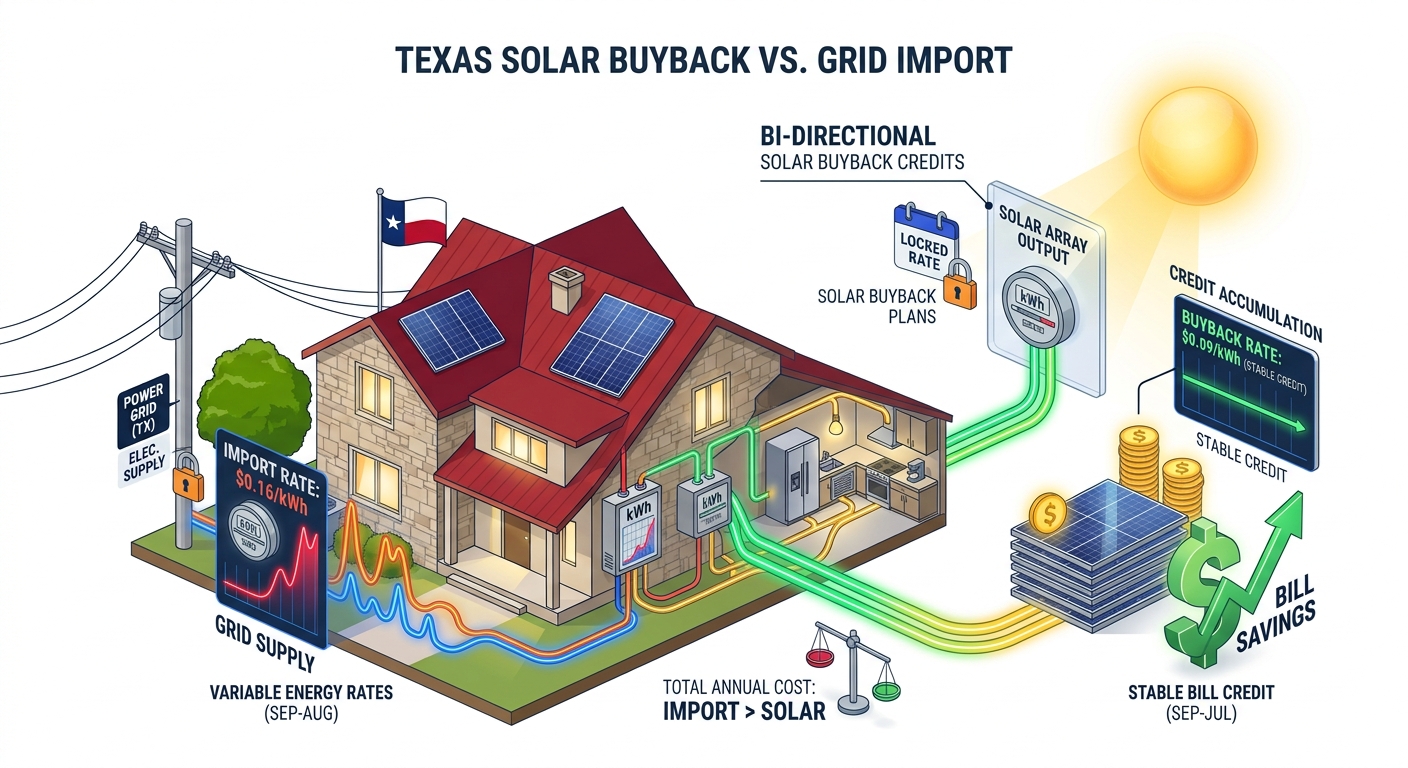
Utilities across the country have moved to net billing frameworks - California's NEM 3.0 being the most high-profile example, but the same pattern is playing out in deregulated markets like Texas. Under these new structures, the grid is no longer your free battery. The power you export during the day gets credited at a wholesale rate - often just 5 to 10 cents per kWh - while the power you pull back in the evening costs you the full retail rate of 30 to 40+ cents per kWh.
The grid went from being your partner to being your middleman. And that middleman is taking a massive cut.
Selling for Pennies, Buying for Dimes
Here is where the math gets brutal for solar-only homeowners.
Peak solar production happens between 11 AM and 3 PM. For most families, that is also when the house is empty - everyone is at work or school. The air conditioning is running on a moderate schedule, but total consumption is relatively low.That means a huge surplus of solar power has nowhere to go except the grid. Without a battery, every excess watt is automatically exported at the utility's buyback rate.
Then the evening hits. The family comes home. The oven turns on. The AC cranks up. Screens light up in every room. Energy demand spikes right as the sun goes down and solar production drops to zero.
And that is exactly when Time-of-Use (TOU) rates hit their peak - the most expensive electricity of the entire day.
| Time of Day | What Happens | Rate |
|---|---|---|
| 11 AM - 3 PM | Solar overproduces, home is empty | Export at 5-10c/kWh |
| 5 PM - 9 PM | Family home, sun down, demand spikes | Buy at 30-40c+/kWh |
Over the course of a year, that gap can easily cost a solar-only homeowner $500 to $1,200 in lost value - power they generated for free but could not use when it mattered.
Enter the Battery
A home battery changes the entire equation. Instead of exporting your surplus to the grid at wholesale prices, you store it and use it yourself during the expensive hours.
This strategy is called self-consumption, and it is the single biggest financial lever in residential solar today.
How It Works
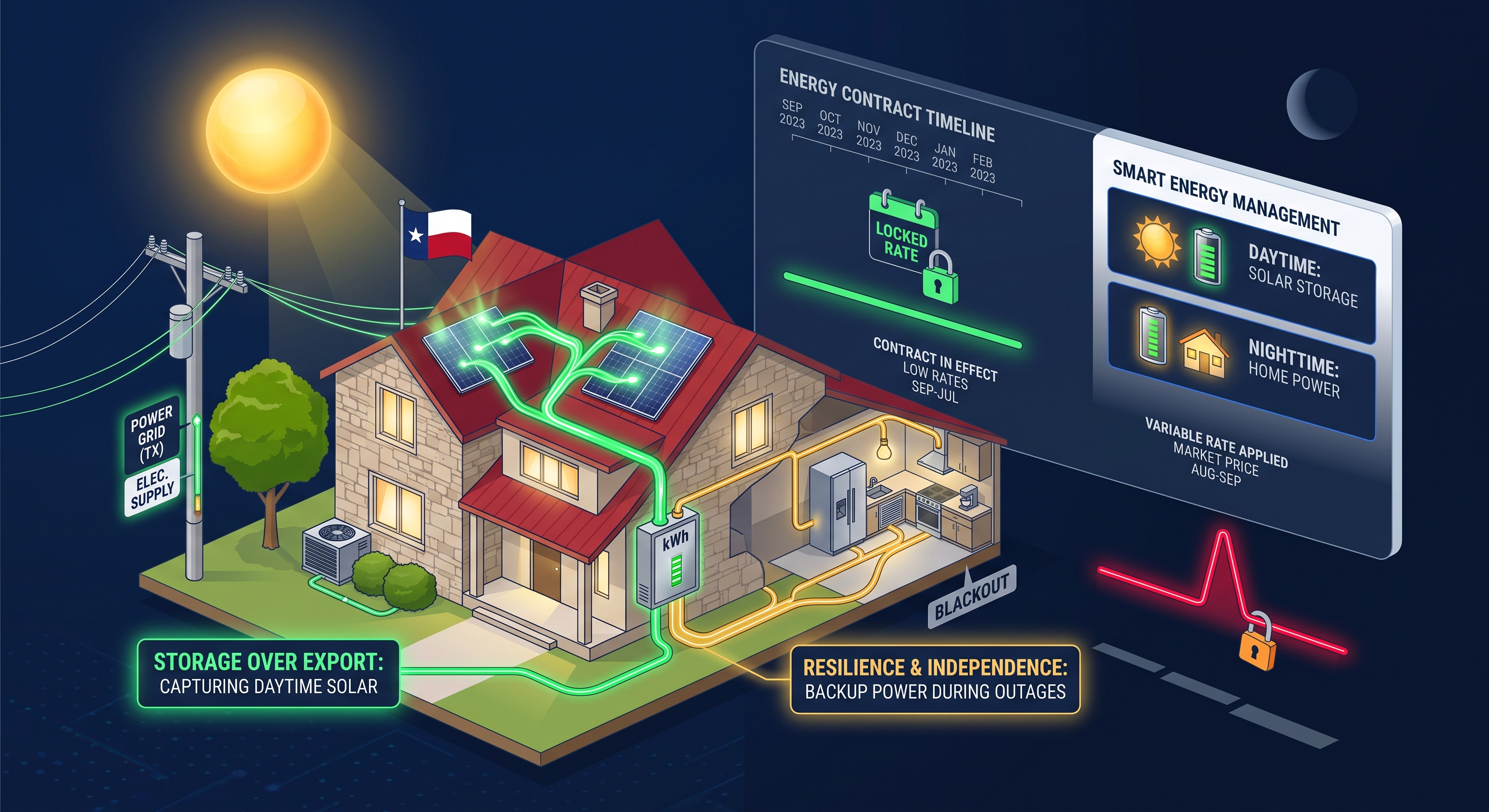
During peak solar hours, your panels charge the battery with 100% free electricity. When the sun sets and TOU rates spike, your home switches to battery power automatically. You are running on energy you already generated - at zero cost - during the exact hours the grid charges the most.
This is called peak shaving: you are literally shaving off the most expensive slice of your electricity bill every single day.
The Math Shift
| Scenario | Evening Energy Source | Cost per kWh |
|---|---|---|
| Solar only (no battery) | Grid at peak TOU rate | 30-40c |
| Solar + battery | Stored solar energy | 0c |
For a typical Texas home generating 30-40 kWh of daily surplus, that difference adds up to $100 to $200 per month in retained value compared to exporting everything.
From Expense to Income: Virtual Power Plants
Here is where batteries get genuinely exciting.
A Virtual Power Plant (VPP) is a network of thousands of individual home batteries, coordinated by software, that function as a single distributed power source. Companies like Tesla Electric, OhmConnect, and various retail energy providers run these programs across the country.
How You Get Paid
When the Texas grid is under extreme stress - a scorching August afternoon where ERCOT is issuing conservation alerts - VPP software can automatically dispatch stored energy from your battery to help stabilize the grid.
In exchange, you earn premium dispatch credits or wholesale market rates that are entirely unavailable to solar-only homeowners. During grid stress events, wholesale prices in ERCOT have spiked to $5,000+ per MWh - the kind of rates that can translate to $20 to $50 per month in VPP credits for a single household battery.
Your battery is no longer just avoiding a cost. It is generating income.
Who Offers VPP Programs in Texas
Several providers are actively enrolling battery owners:
- Tesla Electric - Tesla Powerwall owners can enroll through the Tesla app
- OhmConnect - works with multiple battery brands
- Various REPs - some retail electric providers offer VPP credits as part of their solar buyback plans
The One Thing Nobody Mentions: Blackout Protection
There is a critical fact about grid-tied solar that most homeowners do not learn until it is too late.
A solar-only system without a battery shuts down during a power outage.This is not a design flaw - it is a safety requirement. When the grid goes down, line workers need to be certain there is no live power feeding back into the wires they are repairing. A grid-tied inverter is required to disconnect immediately.
That means during the exact scenario where you would most want your solar panels working - a summer blackout, a winter storm, a grid emergency - your panels sit on the roof doing nothing.
A battery changes that. With a battery-backed solar system, your home can island itself from the grid and continue running on stored and actively generated solar power. Lights stay on. Refrigerator keeps running. Medical equipment stays powered.After Winter Storm Uri in 2021 knocked out power for millions of Texans for days, battery backup stopped being a luxury feature. It became the point.
Not Ready to Install? Portable Batteries Fill the Gap
A whole-home battery like a Tesla Powerwall or Enphase IQ is the gold standard, but it requires installation, permitting, and a significant upfront investment. If you are renting, not ready to commit to a full solar system, or simply want outage protection now while you plan your next move, portable power stations offer a practical middle ground.
These units charge from a standard wall outlet (or a portable solar panel) and store enough energy to keep critical appliances running during an outage. They are also useful for peak-hour power bill arbitrage: charge during cheap off-peak hours, then run your most power-hungry devices from the battery during expensive evening TOU windows.
A few worth considering:
- DJI Power 2000 - 2,048 Wh capacity with 3,000W output, bundled with a 200W solar panel for off-grid charging
- Anker SOLIX S2000 - 2,010 Wh with solar charging capability and a compact footprint
- EcoFlow DELTA 3 Max Plus - 2,048 Wh with 3,000W output and fast wall charging
- Jackery HomePower 3600 Plus - 3,584 Wh for extended runtime, expandable with additional battery packs
- BLUETTI Elite 400 - 3,840 Wh with 2,600W output, one of the largest portable options available
None of these replace a whole-home battery for full solar self-consumption, but they do provide meaningful outage protection and a way to start capturing TOU savings before committing to a larger system. Browse more options in our portable power directory.
As an Amazon Associate, GridWise earns from qualifying purchases.
How Many Batteries Do You Actually Need?
This is the question most solar homeowners never get a straight answer to. Installers size systems based on rough estimates and sales targets. The reality is that the right number of panels and batteries depends entirely on how your household uses electricity across every hour of every season.
If you are shopping for an installer, our Texas solar installer directory compares top-rated companies across all four regions with Google reviews and BBB grades to help you find the right fit.
WattTrim's free Solar Study uses your actual 12 months of Smart Meter data to calculate exactly what your system needs to reach 100% coverage:- Additional panels needed - based on your real consumption vs. current production, not a generic roof estimate
- Battery count for full outage protection - how many units it takes to keep your home running through a grid event, sized to your actual overnight and peak demand
- Battery count for maximum ROI - the sweet spot where VPP credits and peak shaving offset the cost of each additional battery
- Cost projections - what the additional panels and batteries would cost and how long until they pay for themselves through reduced bills and VPP revenue
How WattTrim Helps You Make the Call
Whether you already have solar, are considering adding a battery, or are evaluating the whole package from scratch, the first step is understanding your actual energy profile with an energy monitor and a smart power strip for managing smaller loads.
WattTrim analyzes your real Smart Meter Texas data - 12 months of 15-minute interval readings - to show you:
- Your day vs. night usage split - how much of your consumption falls in peak TOU hours vs. off-peak
- What you are actually paying on your current plan, including TDU delivery charges
- Which solar buyback plans save you the most based on your specific production and consumption pattern
- VPP credit impact - if you are enrolled in a VPP program, WattTrim factors those credits into your savings calculation so you are comparing apples to apples
The old playbook - slap panels on the roof and let the grid sort it out - is dead. The new playbook is about self-consumption, peak shaving, and turning your home into a micro power plant.
The math has changed. Make sure your setup has changed with it.
Ready to Find Your Best Plan?
Browsing plans is a great start - but every home uses electricity differently. WattTrim analyzes your actual Smart Meter usage data to find the cheapest plan for how you use power, not just a generic benchmark.
Run Your Personalized AuditPut This Knowledge to Work
Compare your current plan against 1,500+ options across all 6 Texas TDU service areas, including exclusive broker-negotiated rates not found on PowerToChoose.org. Always free.
Trim My Bill