Why Tiered Electricity Pricing Is Tricky for Non-Solar Customers
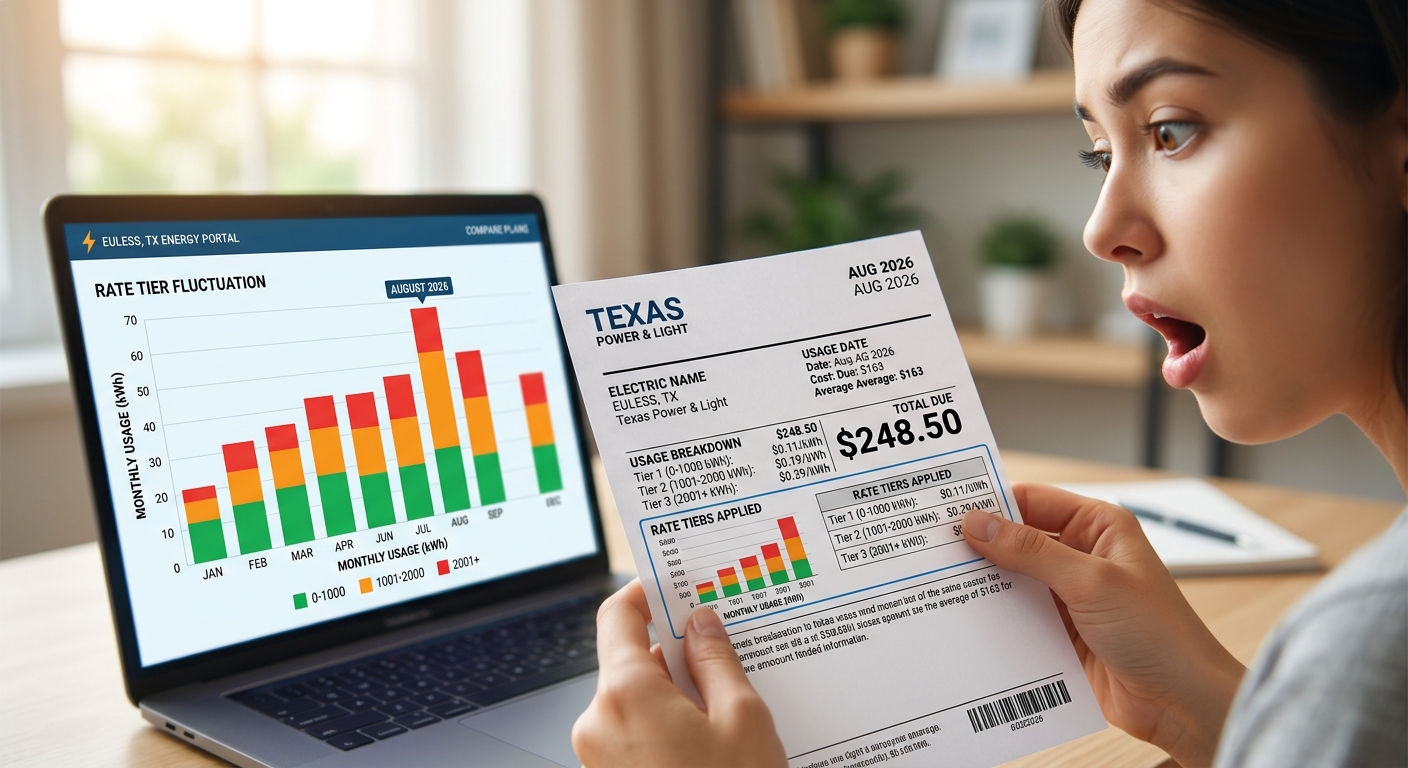
Tiered Texas plans often use bill credits that create a narrow usage sweet spot, so a plan advertised at a low rate at 1,000 kWh can become expensive at 500, 999, or 2,000 kWh. Since non-solar households' usage changes across seasons, compare all EFL benchmark prices and calculate each plan against the home's full monthly usage pattern.
You see an electricity plan advertised at 8.5 cents per kWh. Sounds great, right? You sign up, use electricity like you normally do, and then your first bill arrives - and it's higher than what you were paying before.
Welcome to the world of tiered pricing. It's one of the trickiest parts of shopping for electricity in Texas, and it catches non-solar customers off guard more than almost anything else.
What Is Tiered Pricing?
In Texas, every electricity plan comes with an [Electricity Facts Label (EFL)](/learn/how-to-read-texas-efl). The EFL is required by the Public Utility Commission of Texas (PUCT) and shows you the average price per kWh at three usage levels:
- 500 kWh (low usage)
- 1,000 kWh (average usage)
- 2,000 kWh (high usage)
The Bill Credit Trap
Here's why. Many plans include bill credits - a fixed dollar amount subtracted from your bill when you use more than a certain threshold. A common structure looks like this:
| Component | Amount |
|---|---|
| Energy charge | 11.5 cents/kWh |
| TDU delivery | ~4.2 cents/kWh |
| Bill credit (at 1,000+ kWh) | -$50.00 |
> (11.5 cents x 1,000) + (4.2 cents x 1,000) - $50 = $107 = 10.7 cents/kWh
But at 999 kWh? You lose the entire $50 credit:
> (11.5 cents x 999) + (4.2 cents x 999) = $156.84 = 15.7 cents/kWh
One kWh difference. Five cents per kWh swing. That's a $50 cliff hiding in the fine print.
The "Sweet Spot" Problem
This means tiered plans have a sweet spot - a usage range where the math works in your favor. Outside that range, you could be overpaying significantly.
Here's what a typical tiered plan actually looks like across different usage levels:
| Monthly Usage | Effective Rate |
|---|---|
| 500 kWh | 15.7 cents/kWh |
| 750 kWh | 12.3 cents/kWh |
| 999 kWh | 15.7 cents/kWh |
| 1,000 kWh | 10.7 cents/kWh |
| 1,200 kWh | 11.2 cents/kWh |
| 2,000 kWh | 12.1 cents/kWh |

Why This Matters for You
If you're a non-solar customer in Texas, your usage changes every month. You might use 800 kWh in April and 2,200 kWh in August. A plan that saves you money in spring could cost you more in summer.
Most comparison sites - including the official PowerToChoose.org - show you the rate at 1,000 kWh. That's helpful as a starting point, but it doesn't tell you what you'll actually pay across a full year of real usage.
How to Protect Yourself
1. Look at all three EFL price points, not just one. If the rate at 500 kWh is dramatically higher than at 1,000 kWh, there's probably a bill credit creating an artificial sweet spot.
2. Know your actual monthly usage pattern. Your Smart Meter records your real consumption every month. If your usage swings between 600 and 1,800 kWh seasonally, you need a plan that works across that entire range. WattTrim pulls your Smart Meter data automatically and compares it against every available plan in your service area so you can see exactly what each one would cost at your actual usage levels.
3. Calculate your cost at YOUR usage, not the advertised usage. The only way to know what a plan truly costs you is to run your actual monthly numbers through each plan's rate structure - not just multiply your usage by the advertised rate.
4. Consider flat-rate plans. Plans with no bill credits and a simple per-kWh rate are more predictable. You won't get the flashy low number at 1,000 kWh, but you also won't hit any cliffs. What you see is what you get.
The Bottom Line
Tiered pricing isn't inherently bad - some customers genuinely save money on these plans. But the savings only happen if your usage consistently lands in the right range. For everyone else, it's a pricing structure that looks cheap but costs more.
When WattTrim runs your electricity audit, we calculate your cost on every available plan using your actual month-by-month usage - not just the advertised rate. We interpolate between the EFL anchor points to find your true cost at every usage level, including the months where you'd fall outside the sweet spot.
That's the difference between picking a plan based on a single number and picking one based on 12 months of reality.
Put This Knowledge to Work
Compare your current plan against 1,500+ options across all 6 Texas TDU service areas, including exclusive broker-negotiated rates not found on PowerToChoose.org. Always free.
Trim My BillGridWise Audit shows the plans. WattTrim audits your bill to find your savings.
Keep Reading

Frequently Asked Questions
What is tiered electricity pricing in Texas?
Tiered plans can use usage thresholds and bill credits that change the effective price at different consumption levels. A low advertised rate may apply only at a narrow benchmark such as 1,000 kWh.
Why can using one less kWh make my bill much higher?
A bill credit can disappear entirely when usage falls just below its threshold. In the example, using 999 rather than 1,000 kWh removes a $50 credit and sharply increases the effective rate.
How can non-solar customers avoid a tiered plan surprise?
Review all three EFL benchmarks and compare each plan against month-by-month historical usage. A straightforward flat-rate structure may offer more predictable costs when usage moves substantially by season.