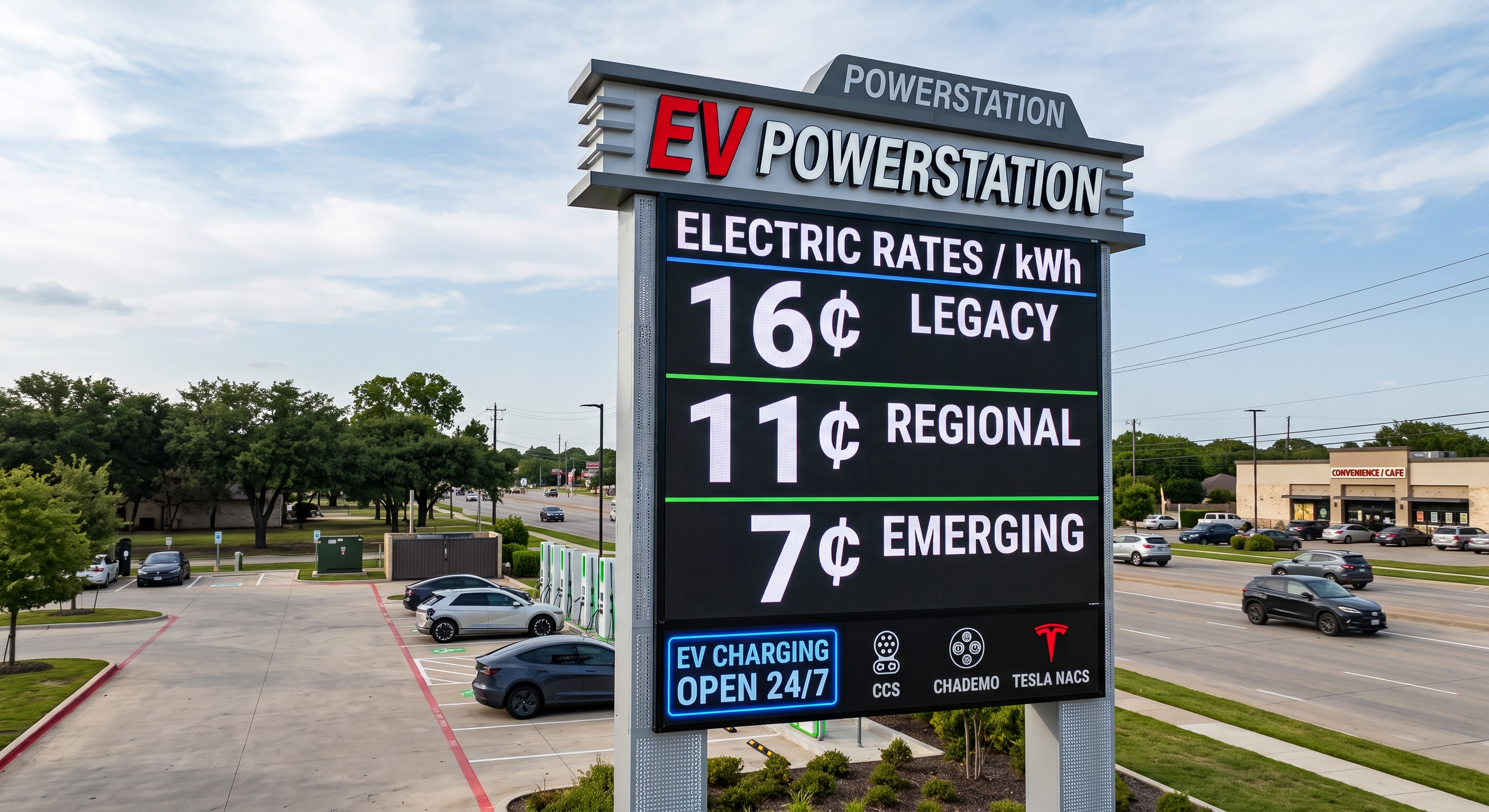
# Why Do We Scream at the Gas Pump But Ignore Our Power Bill
You can spot a gas price from half a mile away.
It is posted on a tall sign beside the road, in numbers big enough to read before you reach the intersection. You see it on the way to work and when you are out getting groceries. When the number jumps, everybody notices. You feel it when you fill the tank and maybe drive a few blocks farther to save a few cents.
But there is only so much any one driver can do. Crude oil prices move for reasons much bigger than a household budget. You can choose the less expensive station on a given day, but you cannot negotiate the price of gasoline.
Your electricity bill works almost the opposite way.
There is no giant highway sign showing what you are paying per kilowatt-hour. The bill arrives quietly once a month, usually after the electricity has already powered every hot afternoon, laundry load, movie night, and early-morning coffee. It creates a brief moment of sticker shock. Then it gets paid, filed away, and forgotten until the next bill brings the same surprise.
That is understandable. Life is busy. Still, it can make electricity one of the easiest household costs to overlook, even though it is one of the costs Texans in competitive areas can often do something about.
The question behind the monthly bill
Based on an analysis of over 1,500 active plans, the competitive benchmark in Texas sits around 11 cents per kWh. Yet 86.7% of active plans are priced above that benchmark, and 46% charge rates well into premium territory at 13 cents or higher.
Rate distribution based on GridWise Audit's database of 1,500+ active plans from 52 providers across all six Texas TDU service areas. See Texas Electricity Rates Today for full methodology.
Those numbers do not mean that every plan above 11 cents is automatically a bad plan. Electricity plans are not all built the same way. A contract may have a different term, a usage credit, time-of-use pricing, or other details that affect what a particular household pays. Delivery charges and other components also matter, which is why it helps to understand TDU fees before comparing a headline rate with a final bill.
But the numbers should make every customer pause and ask a fair question: are you in that 46%?
If your plan is charging 13 cents per kWh or more, it may still have a reason for doing so. The important thing is to know whether that reason benefits your household, or whether you are simply paying more than your actual usage pattern requires. And if you are in the broader 86.7% above the competitive benchmark, it is worth looking at what else is available before assuming your current rate is the going rate for everyone.
Habit is powerful, especially with utilities
People are creatures of habit. Many of us stay with the retail electricity provider we recognize because its name has been around for years, perhaps even before deregulation. Maybe it was the company your parents used. Maybe it was already on the account when you moved in. Maybe a familiar logo, an established website, and a renewal notice made staying put feel like the safe, simple choice.
There is nothing foolish about wanting a provider you can trust. Reliability, clear communication, and responsive customer service matter. The electricity still comes to your home through the same local delivery network, but plan pricing and terms can differ.
At the same time, familiar companies understand the value of familiarity. Branding makes an account feel comfortable, and convenience can make a renewal offer feel like the default decision. That comfort is worth examining when the rate is higher than it needs to be.
Put plainly, you are not paying for better electricity. You may be paying for their marketing budget.
That is not an accusation against any provider. Strong brands can offer good service, and a familiar provider can absolutely be the right choice for a particular home. It is simply a reminder that a recognizable name is not, by itself, proof that a plan remains the best fit. A plan that made sense a year or two ago may no longer match your household, your schedule, or the choices currently competing in your area.

Competition gives Texans real choices
The encouraging part is that Texas has many companies working to earn customers. That competition is a testament to their drive to deliver better service, useful plan designs, and lower rates. It gives households choices that would not exist in a one-size-fits-all market.
Some homes use a large share of electricity overnight. Some families are busiest on weekends. Some households have people working from home, run air conditioning hard during the day, or charge an EV after dinner. Others are out most weekdays and use more power in the evenings. Those patterns can make a meaningful difference when a plan prices different hours differently.
There are plans designed for heavy night or weekend use, plans that can suit strong daytime consumption, and straightforward fixed-rate plans for people who value predictable pricing. If you are deciding whether a stable rate or a changing rate makes more sense, our guide to fixed vs variable rate plans can help clarify the tradeoffs.
It is also important to look past a plan's headline. Some companies offer discounted time frames and offset that discount with higher prices outside those windows. That can be a perfectly understandable plan design for the right customer, but it will not help a household whose largest usage happens during the higher-priced hours. A family that runs the dishwasher late at night but cools a busy home all afternoon may find that the math does not work in its favor. Before choosing that type of plan, it is worth reading about free nights plans and looking carefully at when your home actually uses power.
Other companies compete by finding better ways to source electricity. Chariot Energy, for example, has a daytime plan that sources power from solar providers to reduce costs and pass those savings to customers, without gouging rates outside the discounted hours. That does not make it the right plan for every household. A home that uses most of its energy overnight may have a better match elsewhere. But it is a useful example of what competition can create when a plan is built around a real supply advantage instead of just an attention-grabbing label.
The best plan is personal
The challenge is not that Texans lack choices. The challenge is finding the choice that fits you.
More than 1,500 active plans across 52 providers is a lot to sort through. Even a careful shopper can get lost in contract lengths, base charges, delivery charges, bill credits, minimum-use thresholds, rate periods, and electricity facts labels. A plan may look great at 1,000 kWh but cost more at 1,400 kWh. Another may make sense for a household that is home during the day but not for one that is away until evening.
That is why a monthly total alone does not tell the whole story. Your Smart Meter data shows not only how much electricity your home uses, but when it uses it. That detail is what lets you compare a night-focused plan, a daytime plan, and a more conventional fixed-rate plan on a more honest basis.
It also keeps the search grounded in the details that matter. A very low advertised rate can be tied to a narrow usage range. A bill credit can make one month look excellent and the next month disappointing. A variable price can change after an introductory period. None of those features are automatically wrong. They just need to be understood in the context of your household.
For a practical look at the process, start with how to find the best electricity plan. The goal is not to chase the lowest number printed anywhere. It is to identify the plan most likely to produce the best value for the way you actually live.
You cannot control gas prices, but you can check your plan
Gas prices may be high, and there is not much you can do about the larger forces behind them. You can notice the sign, choose where to fill up, and hope the number comes down.
Electricity is different. If you are in the 46% of plans priced at 13 cents per kWh or higher, or even in the 86.7% above the competitive benchmark, there may be something you can do about your electric bill. You do not have to accept a rate just because it arrived in a renewal email or has been on the account for a long time.
That does not mean everyone should switch immediately. It means everyone deserves a clear comparison before deciding to stay. Check your contract end date, understand any early termination fee, and compare the full structure of your current plan against alternatives that fit your usage. Sometimes staying will be the sensible answer. Sometimes the savings opportunity will be much larger than expected.
Put This Knowledge to Work
Compare your current plan against 1,500+ options across all 6 Texas TDU service areas, including exclusive broker-negotiated rates not found on PowerToChoose.org. Always free.
Trim My BillGridWise Audit shows the plans. WattTrim audits your bill to find your savings.
Keep Reading



Frequently Asked Questions
Why should I review my electricity bill regularly?
Electricity costs can drift upward through rate changes, expiration, fees, or usage changes even when payments are automated. A periodic review helps you catch problems before they compound.
How do I know if my Texas electricity plan is too expensive?
Calculate your all-in cost per kWh from the total bill and compare it with current offers for the same usage and TDU area. Include delivery charges, recurring fees, credits, and contract conditions.
What is the easiest way to compare my electricity plan?
Gather a recent bill and, when available, your interval usage history. Comparing projected annual cost against current plans gives a more reliable answer than comparing a single advertised rate.