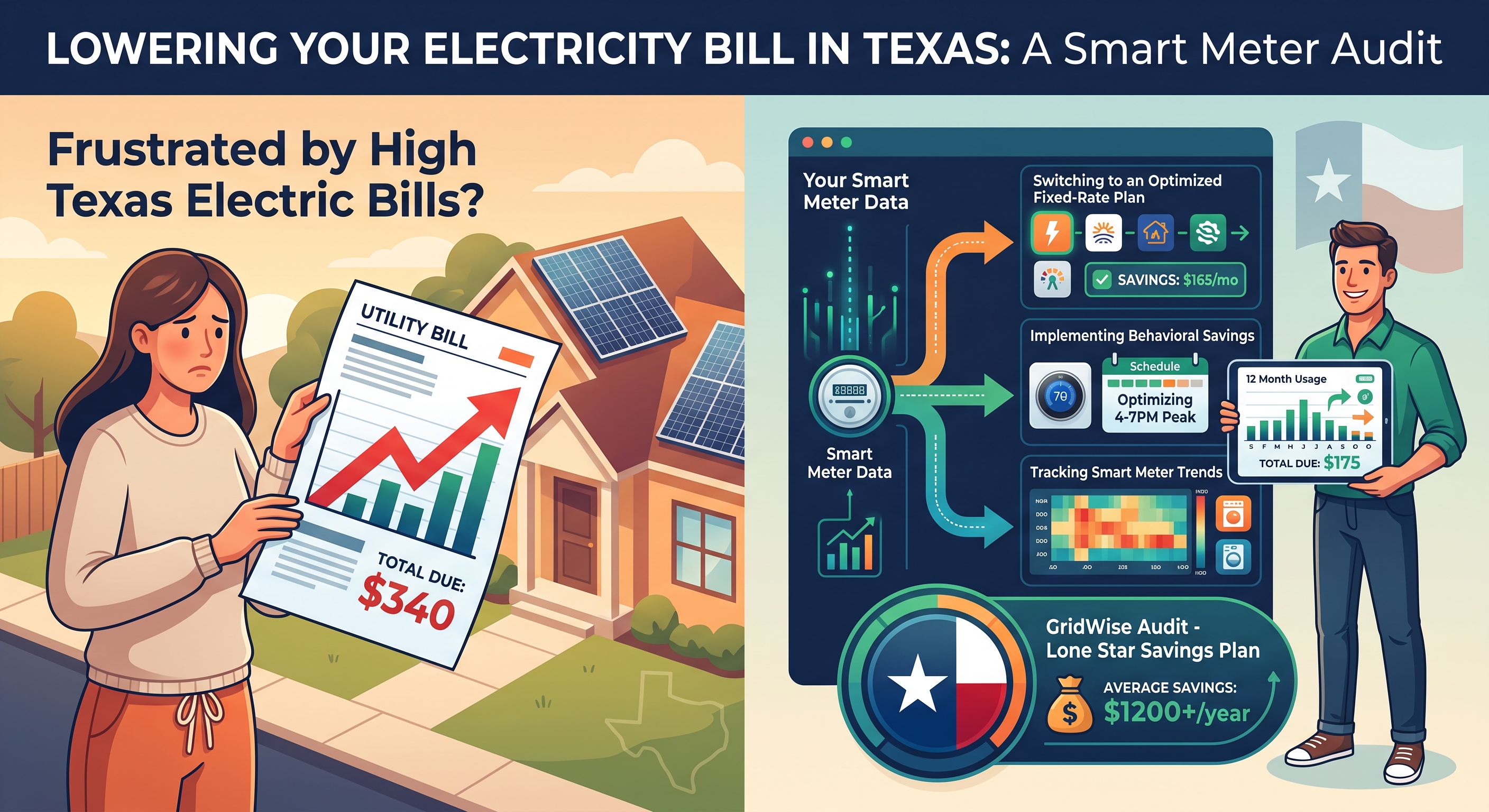
Texas Summer Energy Tips That Actually Lower Your Bill

Texas homeowners can lower summer bills by setting the thermostat near 78 degrees, using fans and window shading, servicing the AC, and shifting major appliances to nighttime when appropriate. The biggest opportunity is checking the contract end date and comparing plans against summer usage, because tiered pricing and bill-credit thresholds can matter more than small habit changes.
June arrives in Texas and the meter starts recording more usage. By July, an electricity bill can easily be much higher than it was in spring. For many households, July and August bills land between $250 and $400, and some homes with high cooling demand see $500 or more.
The good news is that you have meaningful control over summer electricity costs. Here are seven practical ways to bring that bill down, ranked from easiest to most impactful.
1. Set Your Thermostat to 78 degrees F (Yes, Really)
ERCOT, the Texas grid operator, recommends setting your thermostat to 78 degrees F during summer. That might sound warm, but the math is compelling: every degree you set below 78 degrees F costs roughly 3% more on your cooling bill.
Running your AC at 72 degrees F instead of 78 degrees F can increase your cooling costs by 18% or more. On a $300 summer bill where $200 is cooling, that's an extra $36 per month, or more than $100 across the summer.
Key move: Use a programmable or smart thermostat to bump the temperature up 2-3 degrees when you are away or sleeping. Small adjustments can reduce cooling demand without a major change in comfort. See our smart thermostat recommendations for models that pay for themselves in one season.2. Run Major Appliances at Night
Your dishwasher, washing machine, and dryer generate heat. Running them during the afternoon forces your AC to work harder to compensate.
Shifting these tasks to after 9 PM has two benefits: you reduce the heat load on your AC during peak hours, and if you're on a time-of-use plan with free nights, you pay no energy charge (TDU delivery charges still apply) for those appliances during nighttime hours.
Even on a flat-rate plan, running heat-generating appliances at night means your AC does not have to work against them during the hottest part of the day, saving energy and money.
3. Check Your Plan's Contract End Date
This is the tip that can save more money than the others combined, and it takes two minutes.
Log into your electricity provider's website or check your latest bill for your contract end date. If your contract has already expired, your provider may have moved you to a month-to-month variable rate. Compare that product's Electricity Facts Label with current offers and calculate costs at your own usage level.At 2,000 kWh of summer usage, even a meaningful difference in the all-in price can add well over $100 to one month's bill. That makes the expiration date worth tracking before the hottest months arrive.
If your contract expires soon, start shopping now. Texas residential customers can generally switch without an early termination fee when the new service start date is within 14 days of the current contract's expiration date. Read our guide to what happens when a Texas electricity contract expires for the timeline and details. If you are outside that window, review the early termination fee and projected savings before making a change.
4. Use Ceiling Fans (and Raise the Thermostat When You Do)
Running a ceiling fan costs about 1-2 cents per hour. Running your AC costs roughly $1-$3 per hour depending on your system and home size.
But the real trick is this: ceiling fans do not cool rooms - they cool people. The wind-chill effect can make you feel 3-4 degrees cooler. So if you turn on ceiling fans, you may be able to raise your thermostat by 2 degrees F without losing comfort.
That 2-degree increase saves about 6% on cooling costs. On a $300 summer bill, that is about $18 per month in savings for pennies in fan operating costs.
Remember to turn fans off when you leave the room. They help only when someone is there to feel the breeze.

5. Close Blinds on South and West-Facing Windows
Solar heat gain through windows is a major driver of AC load in Texas homes. Afternoon sun through west-facing windows can noticeably raise room temperatures and make your AC run longer.Closing blinds, curtains, or shades on south-facing windows during midday and west-facing windows during the afternoon is a simple, low-cost measure. Blackout curtains or cellular shades can provide more insulation. Weatherstripping tape around leaky window frames can help too.
If you want to go further, exterior shade solutions such as awnings or solar screens block heat before it reaches the glass, making them more effective than interior blinds alone.
6. Get Your AC Serviced Before Summer
Your air conditioning system does more work than any other appliance during a Texas summer. A poorly maintained system runs longer and uses more electricity.
Schedule a tune-up in April or May before HVAC companies are fully booked. A basic service visit typically includes:- Replacing or cleaning the air filter - a clogged filter can increase energy consumption by 5-15%
- Checking refrigerant levels - low refrigerant can lead to longer run times
- Cleaning the condenser coils - dirty outdoor coils reduce heat transfer
- Inspecting ductwork - leaky ducts can send cooled air into the attic rather than your living space
7. Make Sure You're on the Right Plan for Your Summer Usage
Here is a fact that surprises many people: a plan that looks inexpensive at 1,000 kWh per month might be expensive at 2,000 kWh per month.
Many Texas electricity plans use tiered pricing or bill credits that create pricing cliffs. A plan might offer a $75 credit when usage is between 1,000 and 1,500 kWh. At 1,200 kWh, that credit can make the plan attractive. At 2,000 kWh of July usage, the credit may disappear, leaving a higher effective rate.
This is why a plan needs to be evaluated across all seasons, not only at one advertised usage point. For a deeper dive, see why tiered pricing is tricky for non-solar plans.
WattTrim runs every available plan against your actual 12 months of usage data, including high-summer months. Instead of guessing how a plan performs at 2,000 kWh, you can see projected costs for each month of the year.The Biggest Lever: Your Plan Choice
All of the tips above are worth doing. Ceiling fans, smart thermostat settings, and AC maintenance can reduce summer energy use.
But plan selection can make a larger annual difference than any single habit change, particularly if your current plan has expired or its pricing does not match your usage pattern. The most effective summer strategy is a combination: choose a plan that fits your household and use energy thoughtfully.
When you are ready to change plans, follow our step-by-step guide to switching electricity providers in Texas. It explains how to compare terms, schedule the new service, and avoid gaps in service.
For more seasonal tips and product recommendations, visit our Texas Energy Saving Guide.
Compare your current plan against 1,500+ options across all 6 Texas TDU service areas, including exclusive broker-negotiated rates not found on PowerToChoose.org. Always free.WattTrim's plan rankings are based solely on your actual usage data. Provider compensation never influences your results.
WattTrim LLC is a registered Texas Electricity Broker, PUCT License No. BR260145.
Put This Knowledge to Work
Compare your current plan against 1,500+ options across all 6 Texas TDU service areas, including exclusive broker-negotiated rates not found on PowerToChoose.org. Always free.
Trim My Bill