How to Read Your Texas Electricity Bill (Line by Line)
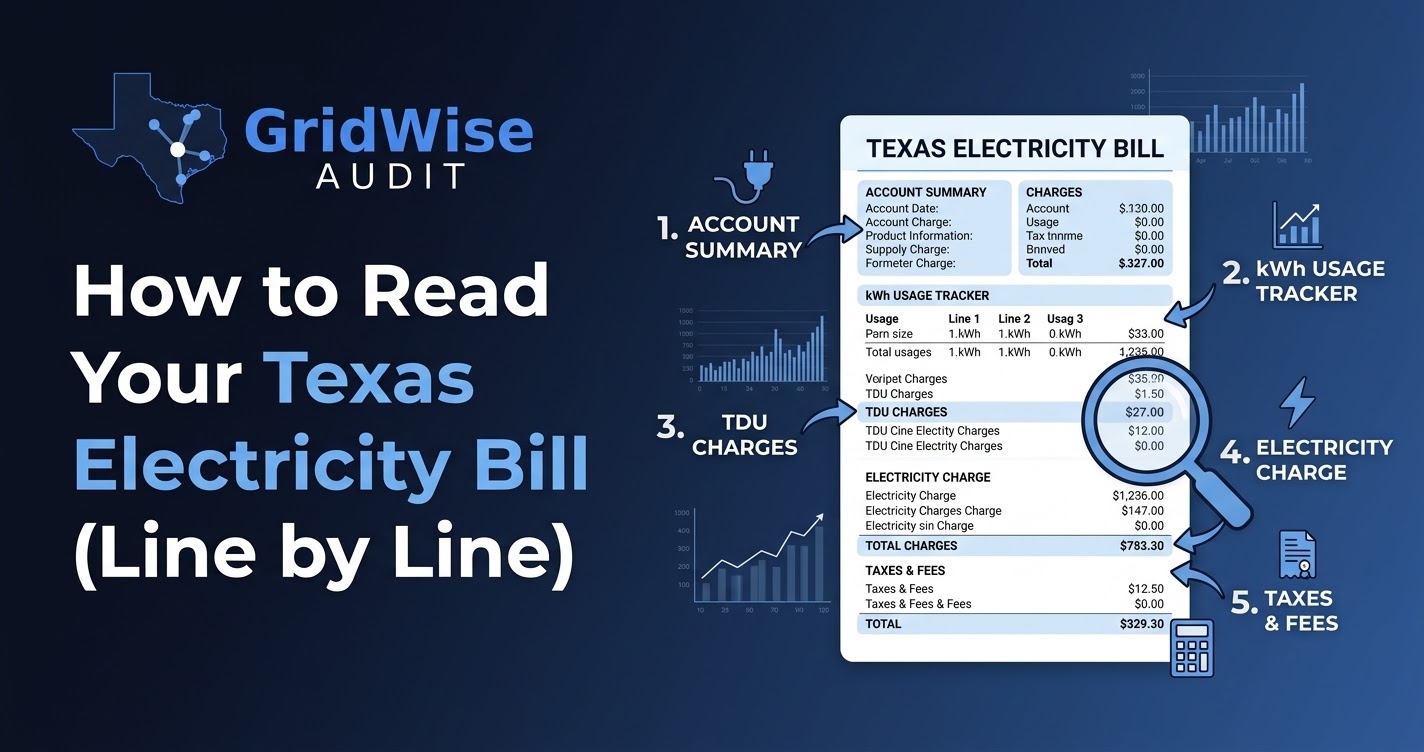
A Texas electricity bill combines REP charges, local TDU delivery charges, and taxes or regulatory fees, with energy rates, base fees, and bill credits making the provider portion especially variable. Divide the total bill by total kWh to find the all-in average price, then compare that figure rather than relying on the advertised energy charge alone.
Your Texas electricity bill arrives every month, and if you're like most people, you look at the total, wince, and pay it. Maybe you glance at the kWh used. But the line items between the top and the bottom? Those might as well be written in another language.
Understanding your bill isn't just an academic exercise. Knowing what each charge means is the first step to knowing whether you're overpaying - and what you can actually do about it.
Let's walk through a typical Texas electricity bill, line by line.
The Big Picture: Three Buckets of Charges
Every Texas electricity bill in a deregulated area breaks down into three main categories:
- Provider (REP) charges - from your Retail Electricity Provider
- TDU delivery charges - from your local utility (Oncor, CenterPoint, AEP Central, AEP North, TNMP, or LP&L)
- Taxes and fees - state and local taxes, regulatory charges
Provider Charges (The Part You Control)
These are the charges from the company you chose when you signed up for an electricity plan - Reliant, TXU Energy, Gexa, Rhythm, Chariot, Green Mountain, or any of the dozens of REPs in Texas.
Energy Charge
This is the big one. It's your per-kWh rate multiplied by the electricity you used. If your plan is 10 cents/kWh and you used 1,500 kWh, the energy charge is $150.
This is the line item you can directly change by switching providers or plans. It's also where the biggest variation exists - the difference between a good plan and a bad one can be 5-10 cents/kWh, which on 1,500 kWh of usage is $75-$150 per month.
Base Fee / Service Fee
Many plans include a monthly flat fee, typically ranging from $0 to $9.95. Some providers advertise "no base fee" plans, but they usually make up for it with a slightly higher per-kWh rate. Whether a base fee plan or a no-base-fee plan is cheaper for you depends on your total usage.
Bill Credits
This is where things get interesting - and sometimes confusing. Bill credits show up as negative line items on your bill. They're essentially discounts that kick in when your usage falls within a certain range.
A common structure: "Receive a $50 credit when usage is between 1,000 and 2,000 kWh." If you use 1,100 kWh, you get the credit and your effective rate drops significantly. Use 999 kWh or 2,001 kWh, and you miss it entirely.
Bill credits are the main reason you can't just compare per-kWh rates between plans. A plan with a 12 cents/kWh rate and a $75 credit at 1,000 kWh is actually cheaper at that usage level than a plan with a 10 cents/kWh rate and no credit. But at 1,500 kWh, the math flips completely.
This is exactly the kind of complexity that WattTrim's piecewise cost interpolation handles - it calculates your cost at your actual monthly usage levels, not just the standard benchmarks.
TDU Delivery Charges (Same for Everyone in Your Area)
What Is a TDU?
TDU stands for Transmission and Distribution Utility. These are the companies that own and maintain the actual power lines, poles, transformers, and meters. In Texas, the main TDUs are:
- Oncor - Dallas-Fort Worth, much of North and West Texas
- CenterPoint - Houston metro area
- AEP Texas - South and West Texas (Corpus Christi, Laredo, etc.)
- TNMP (Texas-New Mexico Power) - scattered areas across Texas
TDU Line Items
You'll typically see two components:
TDU Delivery Charge (per kWh): Usually 3-5 cents per kWh. This is the cost of delivering each kilowatt-hour of electricity to your home through the distribution network.
TDU Monthly Charge: A flat monthly fee, typically $3-$5, for being connected to the grid. Think of it like the base cost of having service, regardless of usage.
Together, TDU charges typically add 4-6 cents/kWh to your effective rate. That's why a plan advertised at "8.5 cents/kWh" on PowerToChoose.org actually costs you 12-14 cents/kWh when you include delivery - and why the all-in rate is the number you should compare.

Taxes and Regulatory Fees
These are typically small - a few dollars per month - and include:
- State sales tax on electricity
- System benefit fund fee - helps fund low-income energy assistance
- Competition transition charges (if applicable)
The Number That Actually Matters
Forget the per-kWh energy rate. Forget the advertised price. The single most useful number on your bill is:
Average Price Per kWh = Total Bill Amount / Total kWh Used
This all-in number captures everything - energy charges, TDU delivery, base fees, bill credits, taxes. It's the true cost of your electricity, and it's the number you should use when comparing what you're paying now to what other plans would cost.
For most Texans on a decent plan, this number should fall between 10-14 cents/kWh. If yours is above 16 cents, something is likely off - an expired contract, missed bill credit thresholds, or simply being on a bad plan.
Common Surprises on Your Bill
Meter Reading Adjustments
Occasionally you'll see an adjustment for a previous billing period where the meter reading was estimated rather than actual. These can cause spikes (or dips) that don't reflect your real usage that month.
Late Payment Fees
Most providers charge $5-$15 for late payments. Some also charge a returned payment fee if a payment bounces. Setting up autopay avoids both.
Deposit Charges
If you had a thin credit history when you signed up, you may have paid a deposit. Some providers list deposit refunds as a credit on your bill after 12 months of on-time payments.
Usage Spikes After Plan Changes
If you switched from a plan with a bill credit to one without, your bill might jump even if your usage stayed the same. Always compare the all-in cost, not just the advertised rate.
Why This Matters for Plan Shopping
Most people compare electricity plans by looking at the per-kWh energy rate and picking the lowest one. But as we've seen, that rate is only one piece of your total cost. Base fees, bill credits, and TDU charges all affect what you actually pay.
WattTrim shows all-in rates for every plan recommendation - including TDU delivery charges, base fees, and bill credit effects at your actual usage level. No surprises when the first bill arrives.
Put This Knowledge to Work
Compare your current plan against 1,500+ options across all 6 Texas TDU service areas, including exclusive broker-negotiated rates not found on PowerToChoose.org. Always free.
Trim My BillGridWise Audit shows the plans. WattTrim audits your bill to find your savings.

Keep Reading


Frequently Asked Questions
What charges appear on a Texas electricity bill?
A bill generally includes REP charges, TDU delivery charges, and taxes or regulatory fees. The REP portion can include an energy charge, a base fee, and bill credits.
How do I calculate the all-in electricity rate on my bill?
Divide the total bill amount by the total kWh used during that billing period. This captures energy, delivery, base fees, credits, and taxes, making it more useful than the advertised energy charge alone.
Can switching electricity providers lower my TDU charges?
No. TDU charges are set for the local service area and are the same regardless of which REP you choose. Switching can change the provider's energy charge and plan structure, but not the local delivery charges.