Every Texas Electricity Plan.
One Honest View.

A smarter way to compare.

Filter by TDU Area:
?
Learn about Profile mode
0 plans
View rates at:
CompareProvider Rate (¢)
Loading plans...
All-in EFL rates at 1,000 kWh (energy + TDU delivery). Plans with bill credits show lower rates at specific usage levels — expand rows to compare.Updated: CT
Showing 00 of 0 plans in Oncor

Rate Trends

Avg Grid PriceERCOT Day-Ahead · ¢/kWh
Grid Price Context

Wholesale ERCOT prices drive retail rates. When grid costs spike, retail plans adjust within weeks.

Browse by Provider

See all plans from a specific company — rates, terms, and service areas.

WattTrim
Which plan is best for YOUR usage?

WattTrim analyzes your actual Smart Meter data to find your lowest true cost — not just the advertised rate.

Trim My Bill →
From WattTrim

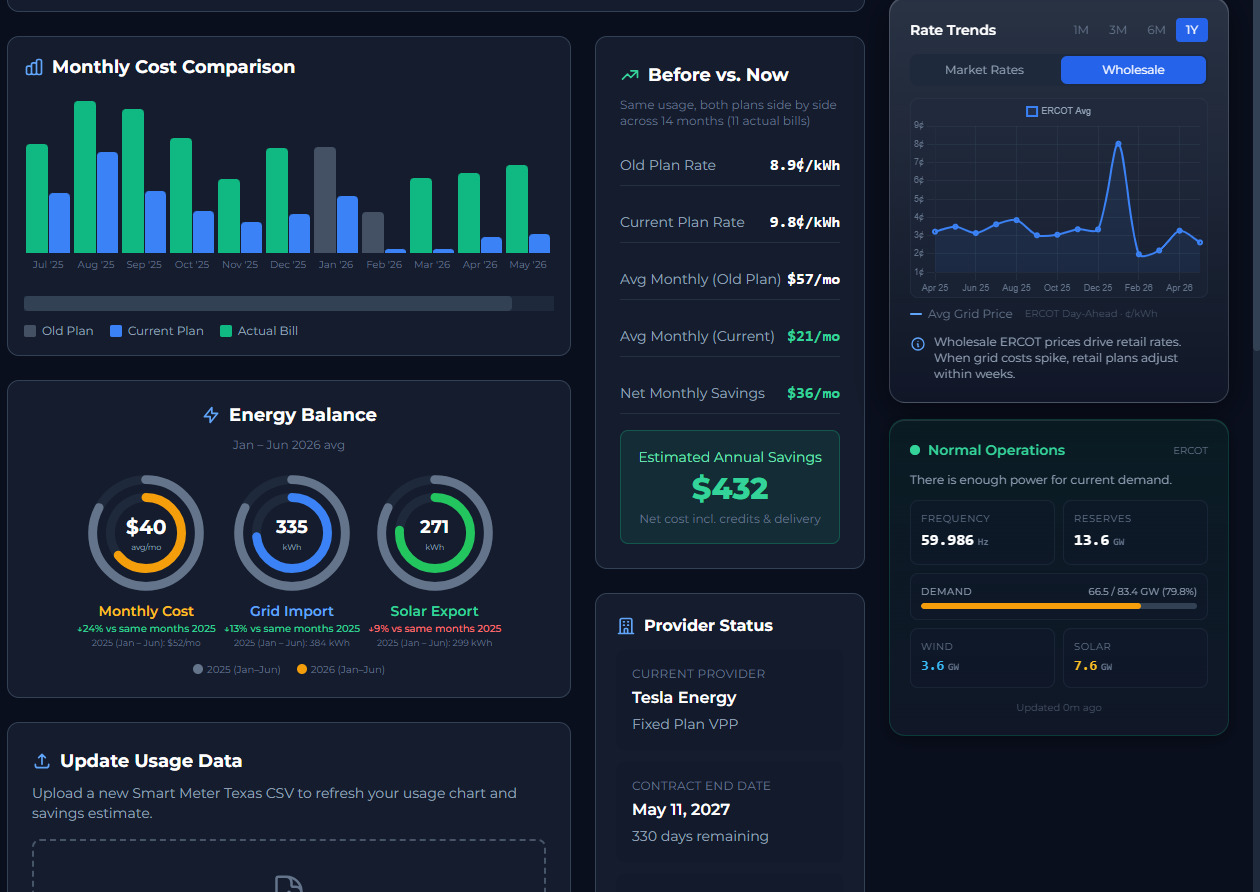
Your Personal Energy Dashboard

A command center that tracks your savings, watches the market, and keeps you ahead of your next bill.

Before vs Now

See your old plan costs side by side with your current savings — real dollars, every month.

Monthly Cost Charts

Visual month-by-month breakdown of what you were paying versus what you pay now.

Live Rate Trends

Track market rate movements and see exactly where your locked-in rate sits compared to the field.

Contract Countdown

Alerts before your plan expires so you never auto-renew into a bad rate.

ERCOT Grid Status

Live demand, reserves, wind and solar generation — know when the grid is under stress.

Free Re-Audits

Upload new usage data anytime — subscribers never pay for another audit.

Subscribers get the full dashboard at gridwiseaudit.com/portal

Start Monitoring — $4.99/mo

Navigating the Texas Electricity Market: A Buyer's Guide

The Texas deregulated energy market offers unparalleled consumer choice, but it also introduces significant complexity. With hundreds of retail electric providers (REPs) competing for your business, finding the cheapest electricity plan requires looking beyond the headline rate. Power companies structure their plans differently, meaning a rate that looks competitive on paper might end up costing significantly more depending on your household's unique monthly usage profile.

When comparing plans on GridWise, the first major decision is choosing between fixed-rate and variable-rate contracts. Fixed-rate plans lock in your supply price per kilowatt-hour (kWh) for the duration of your contract, usually spanning 12 to 36 months. This provides price stability and shields you from seasonal market spikes. Variable-rate plans, by contrast, fluctuate monthly based on wholesale energy market conditions. While they offer the flexibility of no early termination fees, they expose you to extreme price volatility during peak summer or winter months.

It is also critical to distinguish between your retail energy rate and Transmission and Distribution Utility (TDU) charges. TDU fees — often referred to as delivery charges — are set by regulated regional utilities like Oncor or CenterPoint to maintain the physical grid, poles, and wires. These charges are passed through directly to your bill and are identical regardless of which retail provider you choose. Truly transparent comparison platforms account for these non-negotiable fees upfront, ensuring your estimated monthly cost reflects reality, not just marketing promises.


Frequently Asked Questions

How often are the electricity rates updated on GridWise?
Our database syncs continuously with live market data and official Electricity Facts Labels (EFL) to ensure that the rates, tier structures, and base fees you see are completely up-to-date. We actively monitor contract changes across all major Texas REPs so you can compare with confidence.
What exactly is a TDU delivery charge?
TDU stands for Transmission and Distribution Utility. Unlike your retail provider (who buys the electricity), the TDU is the utility company that physically delivers the power to your home and fixes downed power lines. In Texas, these charges consist of a fixed monthly fee and a per-kWh rate. They are approved by the PUCT and cannot be bypassed.
Fixed vs. Variable rates: Which option is better for me?
For the vast majority of Texas households, fixed-rate plans are the safer and more cost-effective option. They secure your rate against severe weather anomalies and market spikes. Variable plans are generally only recommended if you need short-term power for a few weeks and want to avoid early termination fees.
Why does my actual electricity bill sometimes differ from the advertised rate?
Many Texas plans use “tiered” or “minimum usage” pricing structures. For example, a plan might boast a low 10¢/kWh rate only if you hit exactly 1,000 kWh of usage. If you consume 999 kWh or 1,500 kWh, the rate can spike significantly. GridWise explicitly accounts for these usage curves to show you your true average rate.